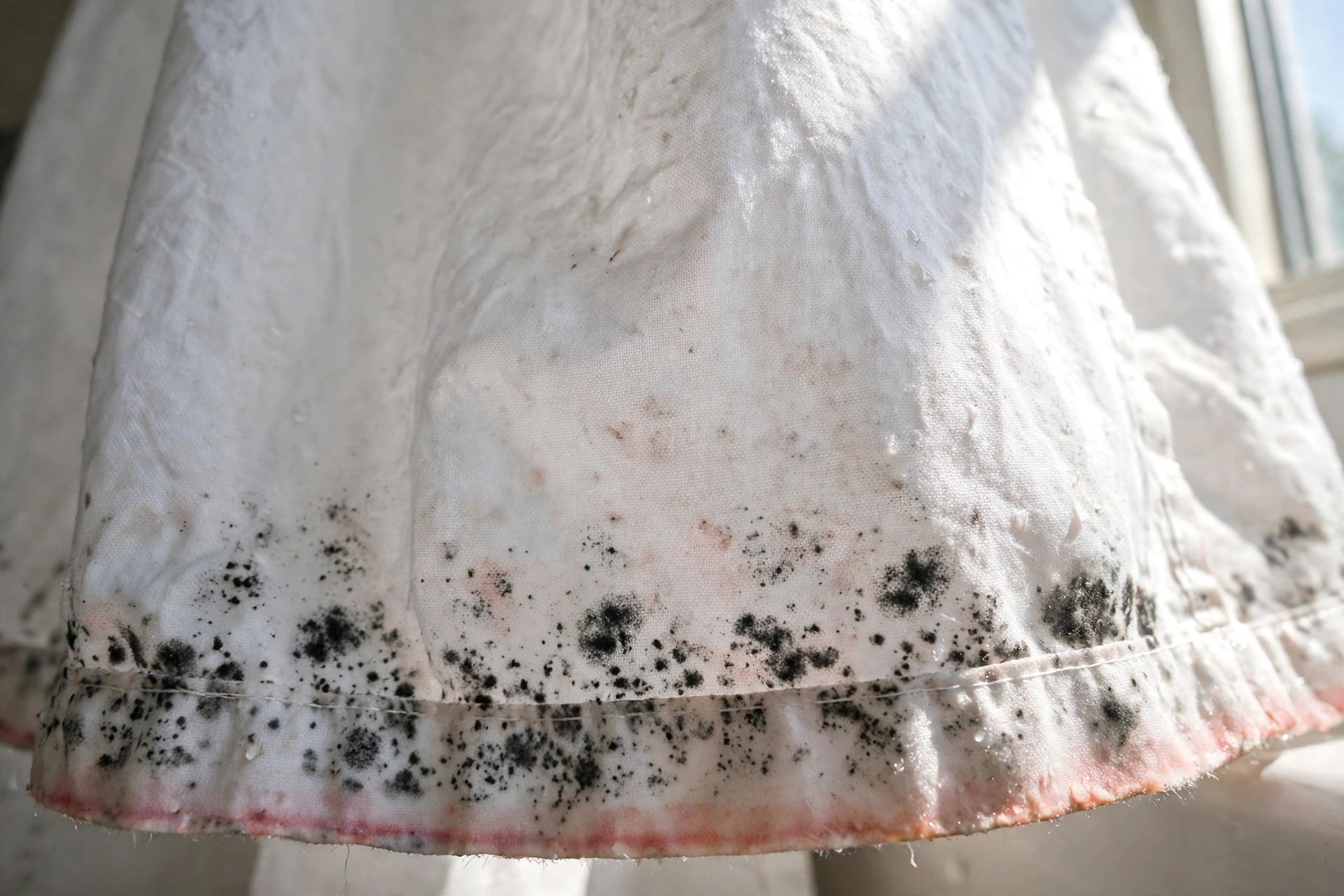

It starts as a faint pink tinge along the bottom hem, or a few grey dots. A month later it is black spots, a musty smell, and a curtain you are slightly embarrassed about. Mildew on a shower curtain is not a sign of a dirty bathroom — it is a sign of a damp one. The curtain stays wet for hours after every shower, folded in on itself, in the warmest room in the house.
The fix depends on one thing: what your curtain is made of. Fabric and plastic need completely different treatment, and using the wrong one either does nothing or ruins the curtain. Get the material right first, and the mildew comes out in one session.
Key Takeaways
How to get mildew out of shower curtain: first check whether the curtain is fabric or plastic/vinyl. Fabric curtains go in the washing machine on a gentle warm cycle with mild detergent and half a cup of vinegar in the rinse (or oxygen bleach for white fabric). Plastic liners get hand-washed in the tub with warm water, detergent and oxygen bleach, or a vinegar soak for light mildew. Never mix bleach and vinegar, never put a plastic liner in the dryer, and spread the curtain fully open after every shower so it dries — that habit stops the mildew coming back.
Table of Contents
Mildew, Mould or Soap Scum? (Know What You Are Looking At)
Not everything on a shower curtain is mildew. Treating soap scum like mould wastes effort, and treating mould like soap scum leaves the problem in place.
| What you see | What it is | What it needs |
|---|---|---|
| Pink or orange film along the bottom hem | Pink mould (Serratia marcescens bacteria) — feeds on soap residue | Vinegar spray or a machine wash; remove the soap residue it feeds on |
| Grey, black or brown spots | Mildew or mould growing on the fabric or vinyl | Vinegar soak or oxygen bleach; longer dwell time than pink film |
| White, chalky haze | Mineral deposits from hard water | Vinegar — the acid dissolves the minerals (same fix as hard water stains on shower doors) |
Most curtains have a mix: pink film at the waterline, black spots at the hem, and a bit of soap scum everywhere. The methods below handle all of it — start with the gentlest one that matches your curtain material.
Fabric or Plastic? (The Decision That Changes Everything)
| Curtain type | How to tell | Cleaning rule |
|---|---|---|
| Fabric (polyester, cotton, linen-blend) | Soft, drapes like cloth, machine-washable label | Machine-wash on gentle, warm water; air dry |
| Plastic / vinyl / PEVA liner | Smooth, slightly stiff, waterproof feel, clear or frosted | Hand-wash in the tub; never machine-dry, never hot water |
| Fabric outer + plastic liner | Two layers on one rod | Wash them separately: fabric in the machine, liner by hand |
If you are not sure, check the care label in the hem. No label? Do the pinch test: fabric feels like cloth and wrinkles when squeezed; vinyl feels smooth and springs back. When in doubt, hand-wash — it is safe for both, just slower.
What You Need
- White vinegar (distilled)
- Baking soda
- Mild laundry detergent
- Oxygen bleach (for white fabric — not chlorine bleach)
- A soft brush or old toothbrush
- Two old towels (for the machine-wash method)
- Rubber gloves
Method 1: Machine-Wash (Fabric Curtains)
This is the easiest method for fabric curtains — the machine does the scrubbing.
Step 1: Shake it out and pre-treat the worst spots. Take the curtain down and shake it outside or over the tub. For visible mildew spots, make a paste of baking soda and water, rub it gently onto the spots with a soft brush, and leave it for 15 to 20 minutes.
Step 2: Load the machine. Put the curtain in with two old towels — they add friction that scrubs the fabric as the drum turns. Do not overload the machine; the curtain needs room to move.
Step 3: Wash on gentle, warm water. Use a small amount of mild detergent. Add half a cup of white vinegar to the rinse cycle (or the fabric-softener dispenser). The vinegar kills mildew, dissolves soap residue and softens the fabric. For white or light fabric with stubborn staining, add oxygen bleach instead of vinegar — it is safe for colours too, despite the name, if you follow the packet dose.
Step 4: Air dry — never tumble dry. Hang the curtain straight back on the rod, spread fully open, and let it air dry. Dryer heat can shrink fabric curtains and melt any waterproof coating. A fan speeds drying. Check the spots now: if a faint shadow remains, one more wash usually finishes it. Two gentle washes beat one harsh one.
Method 2: Hand-Wash (Plastic and Vinyl Liners)
Plastic liners cannot go in the washing machine on a hot cycle — heat warps and melts vinyl — and they should never go in the dryer. Hand-washing is the method.
Step 1: Soak in the tub. Fill the bathtub or a large sink with warm (not hot) water and stir in 1 to 2 tablespoons of mild detergent. If there is visible mildew, add half a cup of oxygen bleach. Submerge the liner, swish it around, and let it soak for 10 to 20 minutes.
Step 2: Scrub the hem and the folds. The bottom hem and the folds are where mildew concentrates, because that is where water sits longest. Scrub those areas with a soft brush and a little baking soda paste. Work gently — hard scrubbing scratches vinyl, and scratched vinyl holds mildew even better.
Step 3: Rinse and hang. Rinse the liner with clean warm water (a handheld showerhead is ideal) and hang it straight back on the rod, spread fully open. Let it air dry completely — do not fold a damp liner and leave it bunched; that is how the mildew got there.
Stubborn Black Mildew
Black spots that survive a wash have usually grown into the material rather than sitting on it. Try each step once before moving to the next.
| Step | Method | When to use it |
|---|---|---|
| 1 | Undiluted vinegar soak, 1 hour | Black spots that survived the first wash |
| 2 | Oxygen bleach soak (packet dose, 1–6 hours) | White or light fabric with deep staining |
| 4 | Replacement | Mildew has stained through, the fabric is breaking down, or the vinyl is stiff and yellowed |
The honest stop rule: if the curtain is stained through and the material feels thin, brittle or permanently stiff, no cleaner will bring it back. A new liner costs very little, and a stained-through curtain keeps seeding mould into the bathroom. Replacing it is not giving up — it is the right call. The same logic applies to black mould on shower caulk: some things clean, some things need replacing.
Safety rule, non-negotiable: never mix bleach and vinegar — together they create chlorine gas. Use one or the other, rinse thoroughly between them, and keep the bathroom ventilated when using bleach.
What NOT to Do
- Do not use hot water on a plastic liner. Heat warps and melts vinyl. Warm water only.
- Do not put a plastic liner in the dryer. It will melt, shrink, or fuse to itself. Air dry only.
- Do not use chlorine bleach on coloured fabric curtains. It bleaches the colour out in patches. Oxygen bleach is the safe alternative.
- Do not mix bleach and vinegar. Chlorine gas. One or the other, never both, and rinse well between them.
- Do not scrub vinyl hard with an abrasive pad. Scratches give mildew somewhere to grip. Soft brush only.
The Drying Habit That Stops It Coming Back
Cleaning removes the mildew. Drying stops it returning — mildew needs moisture, warmth, and still air, and your bathroom provides all three after every shower unless you change one of them.
After every shower, pull the curtain fully closed across the rod — spread flat, not bunched in the corner — so air reaches every fold. Run the exhaust fan during the shower and for 20 minutes after. If your bathroom has a window, open it. A curtain that dries within a couple of hours does not grow mildew; one that stays damp in folds for a day does. The same airflow principle keeps bathroom grout clean — dry surfaces do not grow things.
A monthly curtain wash or wipe-down plus the daily spread-and-dry habit is all it takes. For light pink film on a liner, a weekly five-minute vinegar spray while it hangs is enough. Put it on the same monthly rhythm as the rest of the bathroom — see our home cleaning schedule.
FAQ
How often should I wash my shower curtain?
About once a month for fabric curtains, or whenever you see pink film or spots. Plastic liners benefit from a weekly vinegar-spray wipe and a proper tub soak monthly.
Can I put a plastic shower liner in the washing machine?
Yes — cold, gentle cycle, mild detergent, two old towels, and never in the dryer. Hot water warps vinyl. Hand-washing is safer and just as effective, so it is the method I recommend.
Is vinegar or bleach better for mildew on a shower curtain?
Vinegar is the better first choice: it kills most mildew, dissolves mineral deposits, and is safe on fabric and vinyl. Bleach is stronger on deep black mould but damages coloured fabric, degrades vinyl over time, and must never be mixed with vinegar. Start with vinegar; escalate only if it does not work.
Why does my shower curtain get pink mould?
The pink film is bacteria (Serratia marcescens) feeding on soap residue. It looks awful and comes back fast if soap film stays on the curtain. Vinegar in the rinse and less soap residue both help.
When should I just replace the shower curtain?
When the mildew has stained through the material, the fabric is thinning or tearing, the vinyl is stiff, yellowed or cracked, or black spots survive two proper cleanings. A new liner is cheap; a stained-through curtain keeps seeding mould into the bathroom.
My Honest Take
Here is the truth about shower curtains: nobody’s curtain is special. Every bathroom with a shower grows mildew on the curtain eventually, because every shower leaves the curtain wet and folded. The people with clean curtains are not better cleaners — they just spread the curtain open after every shower and wash it once a month.
So do the wash, get the black spots out, and change the one habit that caused them. Pull the curtain flat after your shower tonight — three seconds. In a month, you will look at the hem and realise there is nothing to clean. The best stain removal is the stain that never happens.


