
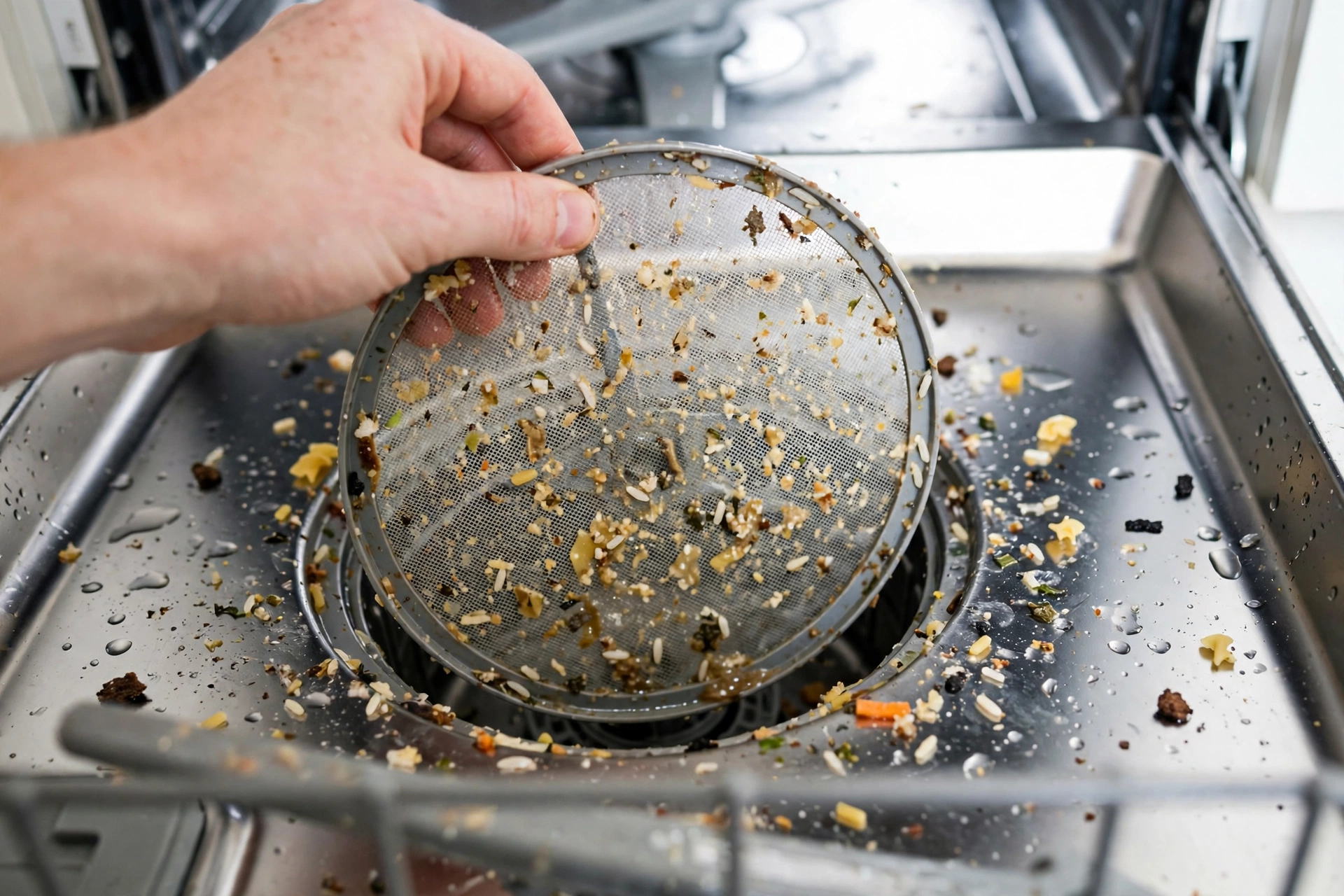

You open the dishwasher to put away clean plates and the smell hits you — sour, musty, like a wet sponge left too long. The dishes look clean, but the machine itself smells like it never got washed. A dishwasher does not clean itself: every cycle leaves a little grease, a few food particles and a film of soap behind, collecting in places you never look.
The fix takes about twenty minutes and works in a specific order. Start with the filter — not a scented tablet, not a lemon, and definitely not an air freshener clipped to the rack. The filter is where the smell lives.
Key Takeaways
How to get rid of dishwasher smell: empty the machine, take out the bottom rack, remove and scrub the filter under hot soapy water, clear the spray-arm holes with a toothpick, wipe the door seal and the bottom of the door, then run an empty hot cycle with a bowl of white vinegar on the top rack, followed by a short hot cycle with baking soda on the floor. Clean the filter monthly and the smell does not come back.
Table of Contents
Why Does a Dishwasher Smell?
A bad smell is a symptom, not a mystery. Work out which kind you have and you will know where to look first.
| Smell | Likely cause | Where to look |
|---|---|---|
| Sour, like old food | Rotting food trapped in the filter | The filter at the bottom of the tub |
| Musty, damp, mildewy | Mould growing in standing water or the door seal | Door gasket, bottom of the door, drain area |
| Rotten egg / sulphur | Grease and food rotting in the drain hose or disposal | Drain hose, disposal, standing water at the bottom |
| Burning or melting plastic | Something plastic melted onto the heating element, or a failing part | Heating element at the bottom — stop and inspect before running again |
Most everyday smells are the first two rows: food in the filter and mould in the seal. Both are fixable in one session. A burning smell is different — do not run another cycle until you have looked at the heating element. Melted plastic on the element is a fire risk, and a failing part needs a technician, not vinegar.
What You Need
- Rubber gloves
- An old toothbrush and a soft cloth or sponge
- White vinegar (distilled)
- Baking soda
- Dish soap
- A dishwasher-safe bowl
The Filter-First Fix (Step by Step)
Step 1: Empty the dishwasher and pull out the bottom rack. Take everything out, including the cutlery basket. You need clear access to the bottom of the tub. Scrub the racks in the sink with hot soapy water while you are at it if they look grimy.
Step 2: Remove the filter. The filter sits at the bottom of the tub, usually a round cylinder or a flat mesh panel near the drain. Twist it anti-clockwise and lift it out. It is often in two parts — a coarse mesh and a fine cylinder — that separate for cleaning.
Step 3: Scrub the filter. Rinse it under hot water, then scrub with dish soap and the old toothbrush. Food, grease and a grey slimy film will come off — that film is the smell. If the mesh is clogged, soak it in hot soapy water for ten minutes first. Rinse until the water runs clear, then put the filter back and twist until it locks. A loose filter lets food straight into the pump, so make sure it clicks home.
Step 4: Clear the spray arms. The arms spray water through small holes, and food particles clog them — which means dirty water does not drain properly and the smell lingers. Lift the arms out if they come off, or work in place: poke each hole clear with a toothpick and rinse the arm under the tap.
Step 5: Wipe the door seal and the bottom of the door. Pull the rubber gasket gently and wipe inside the folds with a damp cloth and a little dish soap. Black spots in the folds are mould — scrub them with the toothbrush. Then wipe the flat area at the very bottom of the door, inside the tub, where water pools after every cycle and never quite dries. This strip is the most commonly missed spot in the machine and often the main source of a musty smell — the same hidden-mould logic as the black mould on shower caulk.
Step 6: Check for standing water. If there is a puddle at the bottom of the tub after a cycle, soak it up with a towel. Standing water usually means the drain hose is blocked or kinked, or the garbage disposal connection is clogged. Check the hose where it meets the sink drain or disposal and clear any blockage before the cleaning cycles.
The Vinegar Cycle and the Baking Soda Cycle
With the filter clean and the seal wiped, the two cleaning cycles finish the job.
The vinegar cycle. Pour two cups of white vinegar into a dishwasher-safe bowl and place it on the top rack. Run the hottest, longest cycle with the machine otherwise empty. Halfway through, pause the cycle for 20 to 30 minutes if your machine allows it, so the vinegar can soak the interior, then let it finish. Vinegar cuts grease, dissolves limescale and kills the bacteria behind most smells.
The baking soda cycle. When the vinegar cycle is done, sprinkle a cup of baking soda across the floor and run a short hot cycle. Baking soda neutralises any odour the vinegar loosened and leaves the tub smelling fresh. Run the two cycles separately — mixing them just makes fizzy water that does neither job properly.
Important: never run vinegar and chlorine bleach in the same machine — together they create chlorine gas. If you have ever used bleach in your dishwasher, run a plain hot cycle first and rinse the tub before any vinegar cycle.
If It Still Smells
If the smell survives the filter clean and both cycles, the problem is deeper than the tub.
| What to check | What you will find | Fix |
|---|---|---|
| Drain hose | Kinked, blocked, or sagging so dirty water flows back | Straighten it, clear the blockage, make sure it loops up high before it meets the drain (the “high loop” stops backflow) |
| Standing water after every cycle | Pump or drain fault | Check the drain filter and hose first; if water still pools, the pump may need a technician |
What NOT to Do
- Do not mask the smell with air fresheners or scented tablets. They cover the odour while the mould and rotting food stay where they are. Fix the source.
- Do not pour bleach in as a first step. Bleach kills mould but does not remove grease or food, and it is dangerous if any vinegar residue is present. Clean first; bleach only if a specific mould problem survives cleaning, and never on stainless-steel interiors (it can pit the steel).
- Do not run the machine half-empty daily to “flush” it. It wastes water and does not clean the filter. A proper clean once a month beats a daily rinse.
- Do not leave dirty dishes sitting in a closed dishwasher for days. That is the smell’s favourite starting point — food rotting in a warm, sealed box. If you cannot run a full load, run a rinse-only cycle.
- Do not ignore standing water. It is not a quirk; it is a drainage problem that will get worse and smell worse.
The Monthly Routine That Keeps It Fresh
| When | What to do | Time |
|---|---|---|
| Every load | Scrape plates (do not pre-rinse — detergent needs a little grease to work), leave the door ajar for an hour after the cycle | 1 minute |
| Weekly | Wipe the door seal and the bottom-of-door strip; check the filter | 3 minutes |
| Monthly | Remove and scrub the filter, clear spray-arm holes, run the vinegar cycle, then the baking soda cycle | 20 minutes |
That is the whole system. Twenty minutes a month and the machine stops smelling — the same “little and often” logic as our home cleaning schedule.
FAQ
Why does my dishwasher smell even though the dishes come out clean?
Because the smell is in the machine, not on the dishes. The filter, the door seal and the drain trap food and grease the wash cycle never reaches. Clean those and the smell goes, even though the dishes were already fine.
Can I use lemon instead of vinegar?
Lemon juice is a mild acid and smells nicer, but white vinegar is stronger on grease and limescale, and far cheaper. A halved lemon on the top rack is a nice finishing touch after the vinegar cycle, not a replacement.
Is it safe to put vinegar in a dishwasher?
Yes, for occasional cleaning cycles on an empty machine: two cups in a bowl on the top rack. Do not pour it into the detergent dispenser, and do not use it every cycle — constant acid can wear rubber seals over time.
How often should I clean the dishwasher filter?
At least once a month if you run the machine most days. If you cook a lot, have a large family, or notice smells, make it every two weeks. It takes three minutes once you know where the filter is.
My dishwasher smells like rotten eggs. What is that?
Usually food and grease rotting in the drain hose or disposal connection, or sulphur bacteria in standing water. Clean the filter first, then check the drain hose and run the disposal with cold water.
My Honest Take
I will be honest: most dishwasher smells are not a broken appliance. They are a filter that has not been touched since the machine was installed. I have seen filters so clogged with grey sludge you could barely see the mesh — and the owner was convinced the machine was dying.
It was not dying. It needed twenty minutes and a toothbrush.
Start with the filter. Scrub it properly. Wipe the seal and the bottom of the door. Run the vinegar cycle, then the baking soda cycle. Then put “first of the month, clean the filter” on whatever list you actually look at. The smell will not come back.
For more kitchen fixes in the same spirit, see our guide to cleaning grease off an oven door — another job that looks awful and takes less time than you think.


