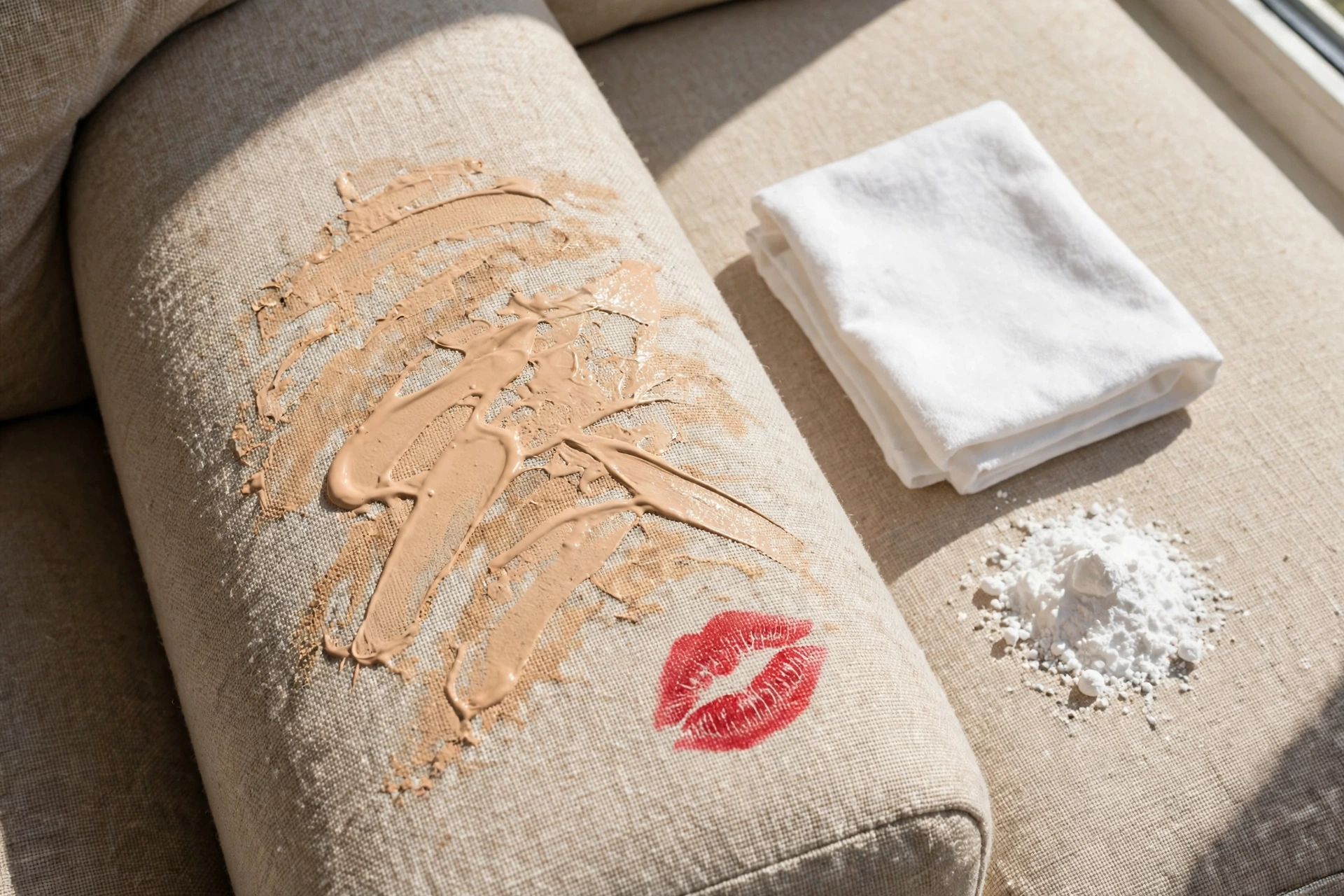

You sit down, lean back, and there it is: foundation on the armrest, or a lipstick mark on the cushion. Makeup on a couch is two problems at once — oil that soaks into the fibres, and pigment sitting on top of it. Treat only one half and the stain comes back the moment the fabric dries.
Most makeup comes out at home with things you already own. The trick is the order — and one rule most people skip: read the cleaning code on your couch before anything wet touches it. That little tag decides everything.
Key Takeaways
How to get makeup out of couch fabric: read the cleaning code first (W, S, WS or X), lift solids with a spoon edge, blot outside in with a clean white cloth, absorb oil-based makeup with baking soda or cornstarch, then clean with the method that matches your code — dish-soap solution for W/WS, rubbing alcohol for S. Never rub, never soak the cushion, and let it air dry fully before you judge the result.
Table of Contents
What Kind of Makeup Is It?
Makeup is not one stain. A powder blush and a long-wear lipstick behave like different substances, and the cleaner that lifts one can set the other. Work out which family the mark belongs to — and if you are not sure, assume oil-based, since water can spread oily pigment across the whole cushion.
| Makeup type | What it is made of | First move |
|---|---|---|
| Liquid foundation, concealer | Oils + pigments | Absorb the oil first (baking soda or cornstarch), then blot with dish-soap solution |
| Lipstick, lip liner | Wax + oil + pigment | Lift solids with a spoon edge, then rubbing alcohol on a cloth for the colour |
| Mascara, eyeliner | Wax + pigment, often waterproof | Blot dry first, then rubbing alcohol or micellar water on a cloth |
| Powder (blush, eyeshadow, face powder) | Dry pigment | Vacuum the loose powder first — never wet it before vacuuming |
| Cream blush, tinted balm | Oil + pigment | Same as foundation: absorb, then dish-soap solution |
Read the Cleaning Code First
Under a seat cushion or along the base of your sofa is a small fabric tag with a letter code — the manufacturer telling you what the fabric can survive. Ignore it and you can leave a water ring, shrink the fabric, or set the stain permanently. If you cannot find the tag, start with the gentlest dry steps and test everything on a hidden spot first.
| Code | Meaning | What you can use |
|---|---|---|
| W | Water-based cleaners are fine | Dish-soap solution, vinegar solution, upholstery shampoo |
| S | Solvent only — no water | Rubbing alcohol, dry-cleaning solvent; water will leave rings |
| WS (or SW) | Either water or solvent | Most methods are safe; start with the gentlest |
| X | Vacuum only — no liquids at all | Dry methods only; call a professional for stains |
A velvet or silk-blend sofa is often code S, and one splash of soapy water leaves a watermark worse than the makeup. Two minutes reading the tag saves the couch. The same “wrong liquid, wrong surface” lesson applies to water stains on wood furniture.
What You Need
- Clean white cloths or white paper towels (white matters — coloured cloths can transfer dye)
- A dull butter knife or spoon edge
- Baking soda or cornstarch
- Clear dish soap (not coloured, not antibacterial with added scents)
- Rubbing alcohol (for S fabrics and for lipstick/mascara)
- Distilled water (tap water can leave mineral rings on some fabrics)
- A vacuum with an upholstery brush attachment
- A spray bottle
The No-Spread Sequence (Step by Step)
The order matters more than the cleaner. Follow this sequence and the stain stays small — skip a step and one spot becomes a whole cushion.
Step 1: Lift, do not smear. If there is any solid or waxy product — lipstick, cream blush, a blob of foundation — lift it gently with the edge of a spoon or a dull butter knife. Scrape toward the centre of the stain, never outward.
Step 2: Vacuum loose powder. If the makeup is powdery (blush, eyeshadow), vacuum it first with the brush attachment held just above the fabric. Wetting dry pigment turns it into a paste that sinks into the fibres.
Step 3: Blot from the outside in. Press a clean white cloth onto the stain, lift, rotate to a clean section, press again. Always work from the outer edge toward the centre. Rubbing pushes pigment sideways and deeper — it is the single most common mistake.
Step 4: Absorb the oil. For anything oil-based, sprinkle baking soda or cornstarch over the mark and leave it for 15 to 30 minutes. It draws the oil out of the fibres. Vacuum it away. This step is the difference between a stain that fades and one that comes back as a grease shadow a week later — the same logic as our guide to body oil on a couch.
Step 5: Clean with the method that matches your code. For W or WS fabrics, mix a few drops of clear dish soap in a cup of cool distilled water. Dampen a cloth with it (never pour solution onto the couch) and blot outside in. For S fabrics, dampen a cloth with a little rubbing alcohol instead and blot the same way. Use tiny amounts — controlled dampness, not a wet cushion.
Step 6: Rinse-blot. Dampen a fresh cloth with plain cool water and blot the area to lift out soap or solvent residue. Residue left behind attracts dirt, and the spot will look grubby again within days.
Step 7: Air dry, then reassess. Let the area dry completely, ideally with a fan nearby. Many stains look gone while wet and reappear as they dry — only when fully dry can you say it worked. If a faint shadow remains, repeat steps 4 to 6 once. Two gentle rounds beat one aggressive scrub.
Method by Makeup Type
| Makeup | Method (after the no-spread sequence) |
|---|---|
| Liquid foundation, concealer | Baking-soda absorb, then dish-soap solution (W/WS). Silicone-heavy long-wear: switch to rubbing alcohol if soap stalls |
| Lipstick | Lift wax, blot with rubbing alcohol, several rounds. On white fabric, oxygen-based upholstery cleaner after the alcohol step |
| Mascara, eyeliner | Blot dry, then rubbing alcohol or micellar water on a cotton pad, rotating to a clean spot |
| Powder makeup | Vacuum first, then a barely damp cloth with dish-soap solution if a tint remains. The same “dry first” rule applies to pet messes — see how to get pet hair out of a couch |
What NOT to Do
- Do not rub. Rubbing spreads pigment and pushes it deeper. Blot only.
- Do not pour cleaner onto the couch. Apply solution to the cloth, never directly to the fabric — pooled liquid soaks into the foam and can leave rings or a musty smell.
- Do not use water on an S-coded sofa. It leaves permanent water rings on solvent-only fabrics.
- Do not use hot water. Heat sets pigment, especially on wool and silk.
- Do not use nail polish remover (acetone). It dissolves acetate and rayon fibres and can strip colour. Rubbing alcohol is the safer solvent.
- Do not use a hair dryer. Heat bakes the stain in and can shrink fabric. Air dry only.
- Do not skip the patch test. Test your cleaner on a hidden spot, wait 10 minutes, and check for colour transfer, stiffness or lightening first.
When to Call a Professional
Call a pro if the tag says X, the fabric is silk, velvet or wool and the stain is large, the makeup has sat for weeks, or pigment is still visible on a white couch after treatment. A pro’s extraction equipment pulls residue out of the foam — something blotting cannot match — and it costs less than re-covering a cushion.
FAQ
Can I use makeup wipes on a couch stain?
As a first blot on a fresh mark, yes — but they are not a full treatment. They leave residue in the fibres, and on S-coded fabrics their moisture can leave rings. Lift the worst of it, then follow the code-matched method above.
Does rubbing alcohol damage couch fabric?
On most synthetic and cotton upholstery it is safe in small amounts, but it can damage acetate, rayon and some silks, and strip colour from delicate dyes. Patch-test on a hidden spot first, and use it on a cloth, never poured directly.
How do I get foundation out of a white couch?
Absorb the oil with baking soda, then blot with a dish-soap solution (W/WS) or rubbing alcohol (S). For a lingering tint, an oxygen-based upholstery cleaner is the next step. Never use chlorine bleach unless the care label explicitly allows it.
What about self-tanner on a couch?
Self-tanner is a dye (DHA) that bonds with fibres — one of the hardest makeup-adjacent stains. Blot immediately, then rubbing alcohol on a cloth, repeated gently. Old marks often lighten but do not fully disappear.
Can I machine-wash a cushion cover to remove makeup?
Only if the care label says the cover is removable and machine-washable. Many covers shrink and will not fit back on, and the stain is often in the foam anyway. Treat it in place first.
Why did the stain come back after it dried?
Either the oil was never absorbed (step 4 was skipped) or soap residue was left in the fibres, attracting dirt. Repeat the baking-soda step, rinse-blot thoroughly, and let it dry completely.
My Honest Take
Makeup on a couch is one of those stains where patience beats products. I have watched someone attack a foundation mark with a wet sponge and a lot of enthusiasm — the mark doubled in size within a minute. That is the story of most makeup stains that “would not come out.” The stain was not unbeatable; the method was wrong.
Read the tag. Lift, do not smear. Absorb the oil before you chase the colour. Blot in tiny amounts and let it dry before you judge. Most makeup comes out with that sequence and nothing fancier than dish soap, baking soda and rubbing alcohol. The couch does not need a miracle product. It needs the right order, and five unhurried minutes.
For the bigger picture on tackling any stain the same calm way, start with our complete stain removal guide.


