
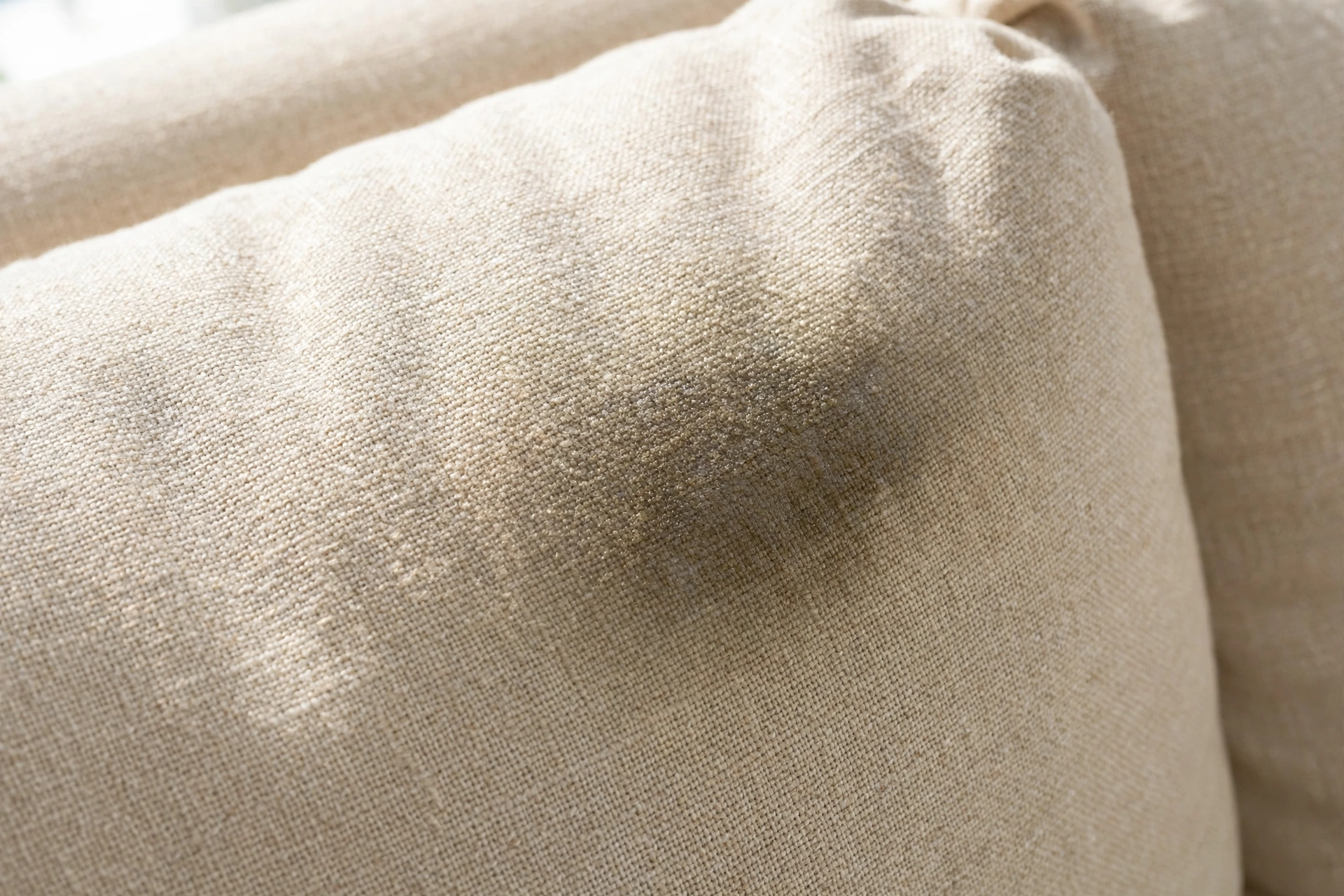

TL;DR: Want to know how to get body oil out of couch fabric? Sprinkle baking soda over the dark patch, let it sit a few hours, then vacuum it up. Blot the remaining mark with a little dish soap in cool water. Test a hidden spot first — and never start with water or soap alone, which drives oil deeper.
Table of Contents
What Those Dark Patches Actually Are
Look at your couch’s headrest, then the armrests. See those darker, slightly shiny patches? That’s not ordinary dirt.
Your skin produces oils constantly, and every lean-back or draped arm transfers a thin layer onto the fabric. Sweat joins in, dust settles on top, and over weeks it all bonds together. Here’s what surprises people: the patches darken because the oil oxidizes — like an apple slice browning in the air. That’s why last month’s faint smudge is a greasy stain now, and why a damp cloth can’t fix it. By the time you notice, the oil has settled into the fibers. Lift it out; don’t push it around.
The Golden Rule: Absorb First, Liquid Second
This is the single most important thing in this whole article.
Oil and water don’t mix. Dab a soapy sponge on an oily patch and the water slides over the oil, pushes it outward, and often drives it deeper — the stain ends up bigger. An absorbent powder like baking soda or cornstarch pulls the oil up and out instead. Both are cheap, already in most kitchens, and safe for upholstery.
The process is simple:
- Vacuum the patch to remove loose dust.
- Cover it generously with baking soda or cornstarch — a visible white layer.
- Leave it for several hours, or overnight for old, dark patches.
- Vacuum the powder up thoroughly.
Only then bring out liquid cleaner: powder lifts the loose oil; liquid cleans what’s left behind.
Check Your Care Code Before You Touch Anything
Flip a seat cushion or check under the couch skirt for the care tag. Its letter code tells you what your upholstery can handle — ignoring it is how people end up with water rings or ruined fabric.
| Code | What It Means | What You Can Safely Use |
|---|---|---|
| W | Water-based cleaners only | Damp cloth, dish soap and water, upholstery shampoo |
| WS | Water-based or solvent-based cleaners | Dish soap and water, or a solvent dry-cleaner |
| S | Solvent-based cleaners only — no water | Dry-cleaning solvent, dry-cleaning sponge; never water |
| X | Vacuum only | Vacuum and brush only; anything else needs a professional |
If your tag says S, water will leave marks — use the solvent route below. No tag? Treat the fabric gently and absorb-and-blot a hidden spot first.
Pick Your Method by Fabric
Match your care code to a method. Don’t improvise — the wrong cleaner on the wrong fabric makes a small patch permanent.
| Fabric Type | Method | Why This One |
|---|---|---|
| W or WS fabric (polyester, most microfiber, cotton blends) | Absorb with baking soda, then dish soap and cool water, blot and rinse | Water-safe fabrics handle mild soap; blotting lifts the remaining oil |
| S-code fabric (some velvets, suedes, delicate blends) | Absorb with cornstarch, then a dry-cleaning sponge or solvent cleaner | Water leaves rings on S fabrics; solvents clean without wetting |
| Leather or faux leather | Absorb, then leather cleaner followed by leather conditioner | Cleaning strips moisture; conditioner puts it back |
| Velvet or suede (usually S-coded) | Cornstarch absorb, solvent only, test hidden spot first | These mark easily and water spots them |
Spill actual food on the couch too? The same blot-don’t-scrub thinking applies — my chocolate on a sofa guide uses the same patience rule.
Step by Step: Fabric Couch (W / WS)
Here’s the full process for a fabric couch with dark, greasy patches on the headrest and arms.
What you need: baking soda or cornstarch, a vacuum with an upholstery attachment, cool water, plain dish soap, and two clean white cloths.
Step 1 — Vacuum the area. Go slowly over the patch with the upholstery attachment to clear the dust layer on top of the oil, so the powder can reach the grease underneath.
Step 2 — Apply the absorbent. Sprinkle baking soda generously over the whole patch, past its visible edges — oils spread wider than they appear. Leave it at least four hours; overnight for months-old buildup.
Step 3 — Vacuum it up. Go over the powder several times from different directions — leftover powder turns into paste when liquid touches it.
Step 4 — Test a hidden spot. Dab a little cleaning solution behind a cushion or under an arm. Wait until it dries. No discoloration or water ring means you’re clear.
Step 5 — Blot with dish soap solution. Mix a few drops of plain dish soap (no moisturizers or fragrances) into cool water. Dip a white cloth, wring until just damp, and blot from the outside edges toward the center — working inward keeps the stain from spreading.
Step 6 — Rinse blot. Dampen your second cloth with plain cool water, wring well, and blot again to lift out the soap — leftover residue attracts dirt.
Step 7 — Dry it right. Press a dry towel over the area to wick up moisture, then let it air dry completely — don’t sit there until it’s fully dry, or you’ll press fresh oil right back in.
These gentle, patient rules of stain removal work across the whole house: absorb first, test first, blot don’t scrub.
What About Leather Couches?
Leather handles body oil differently. The good news: oil doesn’t sink into leather the way it sinks into fabric. The bad news: harsh cleaners and soaking can strip its finish and leave it stiff and cracked.
Start the same way — a light layer of baking soda for a few hours, then vacuum. That pulls up surface oil with no liquid at all. Then use a dedicated leather cleaner (not dish soap, not all-purpose spray), worked in gently with a soft cloth, and condition afterward. Cleaning removes some of the leather’s own moisture; conditioner puts it back. Never soak leather, never use harsh degreasers, and keep vinegar away — acids can damage the finish.
What NOT to Do
This table may be the most valuable part of this article — the mistakes people make most often, each one making the problem worse.
| Do This | Not This |
|---|---|
| Absorb oil first with baking soda or cornstarch | Start with water or soapy liquid — it can push oil deeper |
| Blot gently from the outside toward the center | Scrub in circles — this spreads grease and frays fibers |
| Test every cleaner on a hidden spot first | Assume your couch reacts like everyone else’s |
| Use cool or lukewarm water | Use hot water — heat helps oil bond to fibers |
| Dampen, don’t soak; let cushions dry fully | Flood the cushion — trapped moisture invites mildew |
| Use mild dish soap or a proper upholstery cleaner | Reach for harsh degreasers, bleach, or oven cleaner |
That last one deserves emphasis: a couch is not an engine block. Industrial degreasers can dissolve dyes, weaken fabric, and leave residue that irritates skin — on the very surface you rest your head on.
Why Prevention Is Easier Than the Cure
Once the patches are gone, keeping them away is easy. Oil builds up slowly, so small habits beat big cleanings.
Washable throws on headrests and armrests. This is the single best trick. A throw over the backrest and a runner over each arm catch oil before it reaches the upholstery. Launder monthly and the buildup never starts.
Rotate and flip cushions. If your cushions are reversible, flip and rotate them every few weeks so no single spot takes all the head-leaning.
Vacuum the upholstery regularly. A quick pass with the upholstery attachment every week or two keeps dust from mixing with skin oils and forming that dark layer. Five minutes — it’s part of my own home cleaning schedule for exactly this reason.
Sit less “oily” when you can. Washing your face and hands before an evening on the couch genuinely reduces how much oil transfers. Tie back long hair if the headrest is your usual spot.
FAQ
Will baking soda really pull body oil out of a couch?
Yes — and it’s the safest first step. Baking soda wicks oil up out of the fibers rather than pushing it around. It works best on fresh or moderate buildup and may need repeating on months-old patches, but it removes the bulk of the oil so your liquid cleaner has far less work to do.
Can I use dish soap on a microfiber couch?
Usually, yes — most microfiber couches are W or WS coded, so water-based cleaners are fine. Use a few drops of plain dish soap in cool water on a well-wrung cloth, and blot. Always check your care tag and test a hidden spot first — some microfiber blends are S-coded and shouldn’t get wet.
How do I get body oil out of a leather couch?
Absorb first with a light dusting of baking soda, vacuum it up, then clean with a dedicated leather cleaner and follow with leather conditioner. Skip dish soap as your main cleaner, avoid harsh degreasers, and never soak the leather. The conditioner matters — it replaces the moisture cleaning removes and keeps leather supple.
Why do the dark patches keep coming back after I clean them?
Two reasons. First, the oil goes deeper than the surface you cleaned — wipe only the top and residue underneath wicks back up as it dries. The absorb-first method above fixes that. Second, you add fresh oil every day you sit there, so without washable throws or regular vacuuming the patch rebuilds in weeks.
Can I steam clean body oil off my couch?
Steam can help on W-coded fabrics, but only after the absorb step — heat bonds unabsorbed oil more firmly to fibers. Keep the steamer moving, don’t saturate the fabric, and test a hidden spot. For S-coded fabrics, skip steam; the moisture can leave rings.
The Bottom Line
Dark, greasy patches on headrests and armrests are just body oil, sweat, and dust that bonded and darkened over time — not permanent, and not a reason to buy a new couch. Absorb the oil first with baking soda or cornstarch, clean what remains with a method matched to your care code, and test every step on a hidden spot. Then throw a washable cover over the spot and you’ll rarely deep-clean again.


