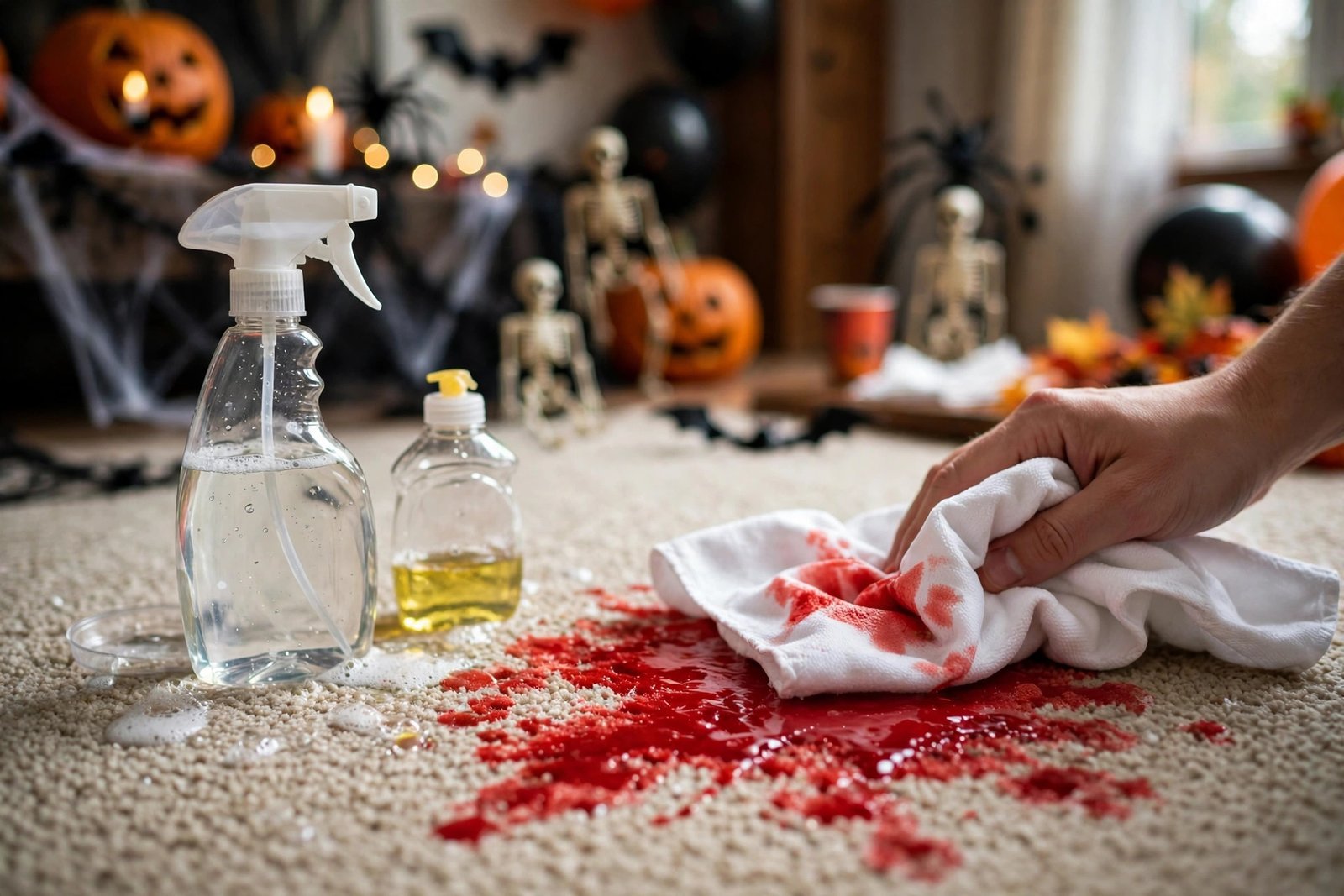

Somebody always bleeds on the carpet at a Halloween party. Not really — but fake blood gets there anyway, usually when a costume gets bumped, a vampire cape brushes a chair, or someone sits down without checking what is on their sleeve. I found a bright red smear on a beige carpet the morning after a party once, and my first thought was the same as yours: that’s never coming out.
It did come out. But fake blood on carpet is a different job from fake blood on clothes, and a different job from real blood, so let me be clear about what you’re actually cleaning. Fake blood is dye, not protein. It’s usually corn syrup and strong food coloring, made to look real and last all night. That means the cold-water protein rules for real blood don’t apply here — and it means heat is still your enemy, because heat locks dye into fibers just as surely. What works is lifting the dye out patiently, in rounds, without ever scrubbing it wider.
The Quick Answer
| Situation | First move | Main mix | For what’s left |
|---|---|---|---|
| Fresh spill (still wet) | Blot up the excess | Cold water + dish soap, blotted | Vinegar solution round |
| Dried stain | Re-wet with cold water | Enzyme cleaner, 15–30 min | Rubbing alcohol dab, then rinse |
| Dark carpet | Same as fresh, but test everything | Dish soap mix only at first | Skip peroxide unless a hidden test passes |
| Light carpet | Same as fresh | Dish soap, then peroxide on a cotton ball if needed | Rinse well, dry under towels |
Table of Contents
What You’ll Need
- Clean white cloths and white paper towels (white matters — dye transfers both ways)
- Cold water and a spray bottle
- Liquid dish soap (clear, no bleach)
- Distilled white vinegar
- Enzyme-based carpet cleaner or stain remover
- Rubbing alcohol (for stubborn dye)
- 3% hydrogen peroxide — light carpet only, after a test
- A dull knife or spoon (for dried, crusty bits)
- A fan
Fresh Spill: Blot, Then Wash It Out
Step 1: Blot up everything you can
Press a clean white cloth straight down onto the spill and lift. Don’t rub, don’t scrub — fake blood dye spreads the moment you push it sideways. Work from the outside edge toward the center and keep switching to clean sections of cloth. This step alone removes most of a fresh spill, and rushing past it is the mistake that turns a spot into a patch.
Step 2: Cold water and dish soap, in rounds
Mix a teaspoon of dish soap into two cups of cold water. Dip a white cloth, wring it out, and blot the stain. Then blot with a dry cloth. Repeat. You’re transferring dye from the carpet to your cloths, a little at a time, and the cloths will show you it’s working — they’ll keep coming up pink for several rounds. The Online Carpets Halloween carpet guide gives the same core advice: blot, cold water with washing-up liquid, and never hot water, because heat sets the dye.
Step 3: Rinse and dry
Blot with a cloth dampened in plain cold water, several times, until no soap feel remains. Soap left in carpet attracts dirt and the spot will look grimy again in a week. Lay dry white towels over it, weigh them down, and let a fan run on it for a few hours. Don’t walk on it until it’s dry.
Dried Fake Blood: Soften It, Then Lift the Dye
Found it the next morning? It’s a longer job, not a lost one.
Step 1: Scrape and re-wet
Gently scrape off any dried, crusty excess with a dull knife or spoon — don’t dig into the fibers. Then mist the stain with cold water until the fibers are damp through. Let it sit for 10 minutes so the dried dye softens.
Step 2: Enzyme cleaner, 15–30 minutes
Apply an enzyme-based carpet cleaner over the stain and let it sit for 15–30 minutes. Enzyme cleaners break down the sticky, dye-carrying part of fake blood without attacking the carpet itself. Blot with a clean cloth, then follow with the dish soap mix from above, blotting in rounds.
Step 3: For a stubborn shadow — vinegar, then alcohol
If a pink shadow remains, mix one part white vinegar with two parts cold water, dampen a cloth, and blot. The vinegar helps break down dye that soap alone won’t move. Still there? Dab rubbing alcohol onto a white cloth and blot gently — alcohol cuts through the dye base that makes fake blood so stubborn. Puracy’s fake blood removal guide recommends the same escalation for persistent marks: enzyme cleaner first, then alcohol for what’s left.
Step 4: Peroxide — light carpet only
On light-colored synthetic carpet, a cotton ball dampened with 3% hydrogen peroxide, blotted onto the stain and left for up to an hour, can finish what everything else started. Test a hidden corner first and wait 10 minutes — peroxide is a mild bleach, and on dark carpet it can leave a light patch worse than the stain. On dark carpet, skip it and repeat the enzyme and alcohol rounds instead.
Step 5: Rinse, dry, vacuum
Rinse by blotting with plain cold water, dry under towels and a fan, and vacuum once fully dry to lift the fibers back up.
What NOT to Do
- Don’t use hot water. Heat locks dye into carpet fibers. Everything here is cold, on purpose.
- Don’t scrub. Scrubbing spreads dye wider and frays the pile — the fuzzy worn patch never looks right again.
- Don’t pour cleaner on the carpet. Apply it with a cloth. Flooding pushes dye and moisture down into the pad, where it wicks back up as the carpet dries.
- Don’t use peroxide on dark carpet without a test. A bleached spot is a bigger problem than a faint pink one.
- Don’t reach for the steam cleaner. Steam is heat plus pressure — the two things that set this stain for good.
My Honest Results
A fresh spill on light synthetic carpet came out completely with the soap rounds alone — it took about six rounds and half an hour, but the carpet looked untouched afterward. A dried stain on the same carpet needed the enzyme step plus a vinegar round, and a very faint shadow survived until the peroxide dab finished it. On dark carpet I skip peroxide entirely, and I’ll be honest: a dried fake blood stain on dark carpet sometimes fades to “you have to know it’s there” rather than disappearing completely. That’s still a win compared to a bright red smear, and it’s the realistic limit of home treatment.
FAQ
Is fake blood harder to remove than real blood?
Different, not harder. Real blood is protein and needs cold water discipline. Fake blood is dye, so it needs dye-lifting rounds — soap, enzyme cleaner, vinegar, alcohol — and patience. The methods don’t transfer between the two, so use the right guide for the right stain.
Does fake blood stain carpet permanently?
On light synthetic carpet, usually not, if you treat it before heat touches it. On dark carpet, or after a hot wash or steam clean, the dye can set and become very hard to shift. Never let a fake blood stain meet heat until it’s out.
Can I use hydrogen peroxide on my carpet?
Only on light-colored synthetic carpet, and only after a hidden spot test. Dab it on a cotton ball, wait 10 minutes on the test spot, and check for lightening before treating the stain itself. Never on wool, silk, or dark carpet without a passed test.
What if the stain comes back after drying?
That’s wicking — dye that reached the pad rising back up. Blot, lightly mist with cold water, blot again, and dry under weighted towels and a fan. If it returns twice, the dye is in the pad and a professional extraction is the realistic fix.
For Further Reading
Fake blood on clothes is a separate method — see How to Get Fake Blood Out of Clothes. For the full carpet system, my carpet stain guide covers every type, and if chocolate was also involved in the party, How to Get Chocolate Out of Carpet is the next one to read.
By Daniel Brown — I test every method in this guide at home before it goes on the site.