
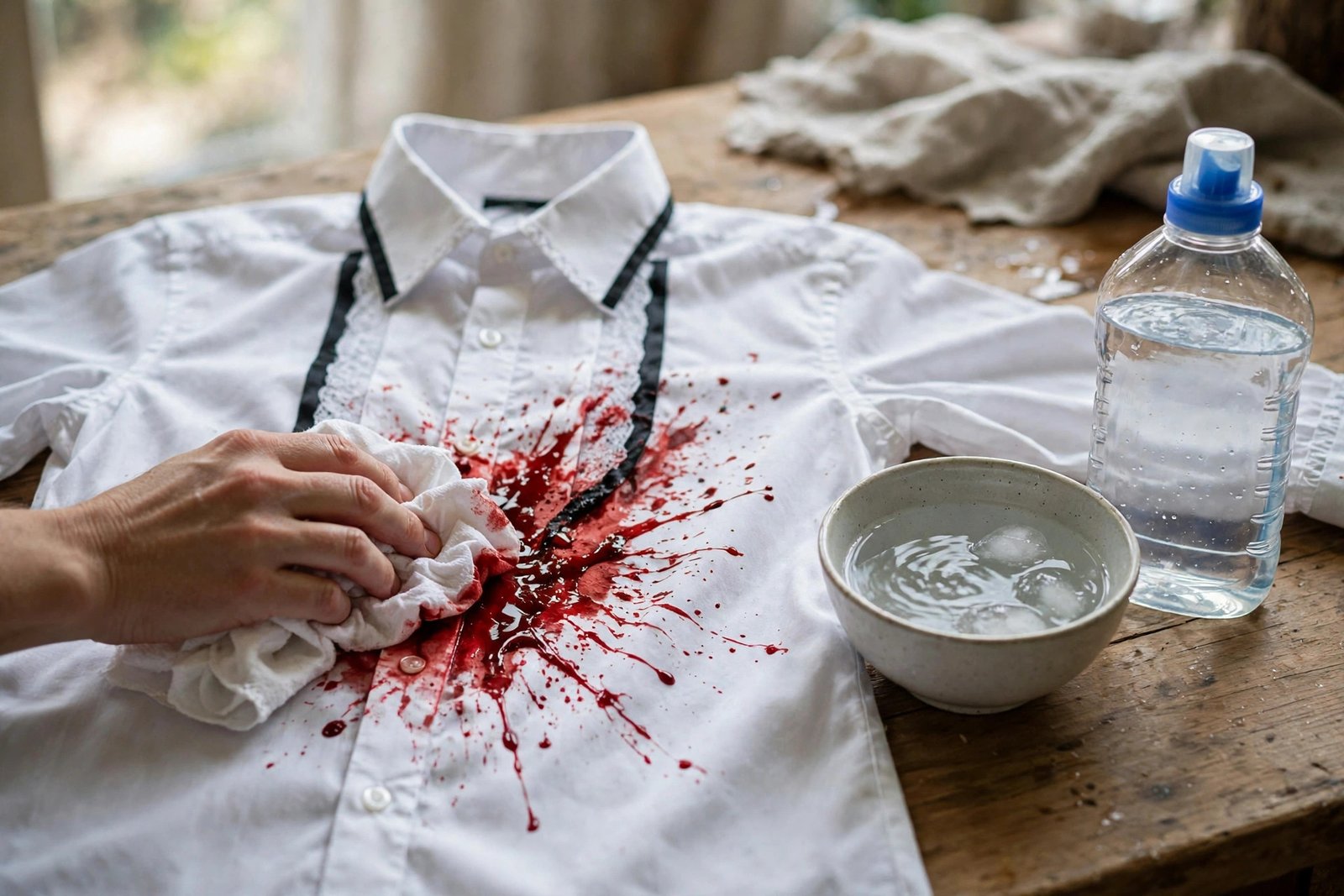

Last Halloween, a vampire cape came home with a perfect red splatter across the front — which was exactly the look, until the party was over and the costume had to survive for next year. Fake blood looks like real blood, but it cleans up differently, and that difference is why so many costumes get ruined in the wash. Real blood is a protein stain. Fake blood is mostly dye — usually FD&C Red #40 — suspended in corn syrup or a similar sticky base. The syrup washes out easily. The dye is the part that fights back.
Here is how to get fake blood out of clothes while the costume is still salvageable, and what to do when the stain has already dried.
Quick Answer
Act fast and keep everything cold. Blot off the excess without rubbing, then flush the stain from the back of the fabric with cold running water to push the dye out the way it came in. Work in a few drops of liquid laundry detergent or clear dish soap, let it sit 10 minutes, then soak the garment in cold water for 30 minutes and wash as usual on the care label’s setting. Check the stain before anything goes in the dryer — heat sets dye permanently, so if colour remains, repeat the treatment instead of drying. For white fabrics, hydrogen peroxide or an oxygen-based bleach soak finishes what soap leaves behind.
Table of Contents
What You’ll Need
- Clean white cloths or paper towels
- Liquid laundry detergent or clear dish soap
- Cold water
- A basin or sink
- Hydrogen peroxide (3%, for white fabrics only) or oxygen bleach
- Rubbing alcohol (for stubborn dye on washable colourfast fabrics)
- An old soft toothbrush
The Steps: Fresh Fake Blood
- Blot, don’t rub. Press a clean cloth straight down on the stain to lift the syrupy excess. Rubbing grinds the dye deeper into the weave and turns a small splatter into a wide pink smear.
- Flush from the back. Turn the garment inside out and run cold water through the back of the stain for a full minute or two. Flushing backwards pushes dye out of the fibers instead of driving it through to the other side. This single step removes more fake blood than anything else in the process.
- Pretreat with detergent. Work a few drops of liquid laundry detergent (or clear dish soap) into the stain with your fingertips or the soft toothbrush, and let it sit for 10 minutes. Detergent breaks up the syrupy base that holds the dye against the fibers.
- Soak cold. Submerge the garment in a basin of cold water for 30 minutes. For a heavy splatter, refresh the water once halfway through. You will usually see the water turn faintly pink — that is dye leaving, which is exactly what you want.
- Wash and check. Launder on the care label’s normal setting, then inspect the stain in good light BEFORE the garment goes anywhere near heat. If a pink shadow remains, repeat steps 3 and 4. Only when the stain is gone should the costume see a dryer or an iron.
Dried Fake Blood
Dried fake blood looks permanent and usually is not. The syrup base has hardened around the dye, so it needs time more than force.
Soak the garment in cold water for several hours — overnight is fine — then pretreat with detergent and wash as above. If a pink or orange tint survives the wash, dab it with a cloth dampened in rubbing alcohol, working from the outside in and moving to a clean section of cloth as the dye transfers. Patch-test the alcohol on an inside seam first: it can pull dye from some fabrics, and the last thing you need is a bleached spot next to the stain you just removed.
For white cotton or polyester, the finishing move is a soak in oxygen bleach (or a careful dab of 3% hydrogen peroxide on the stain itself, 10 minutes, then rinse). Never use chlorine bleach on a coloured costume — it will take the costume’s own colour with the stain.
Fake Blood on Carpet and Upholstery
The same rules apply, minus the washing machine. Blot up the excess, then dab — never scrub — with a cloth dampened in cold water and a drop of dish soap, working outside-in. Rinse the cloth often and keep dabbing with fresh water until no more red transfers. A final dab with rubbing alcohol lifts a dye shadow from light-coloured carpet; spot-test first.
Mistakes to Avoid
- Hot water first. Heat is the enemy of every dye stain. One hot rinse can set fake blood permanently. Cold water until the stain is gone, every time.
- Drying before checking. The dryer is where a faint pink shadow becomes a permanent feature. Inspect before drying, always.
- Treating it like real blood. Real blood needs cold water because heat cooks the protein. Fake blood needs cold water because heat sets the dye. Same rule, different reason — but the same mistake if you ignore it.
- Scrubbing the splatter. Aggressive rubbing spreads the dye and frays costume fabrics, which are often thin polyester. Blot and flush; let the chemistry do the work.
- Skipping the patch test with alcohol or peroxide. Both are strong on dye. Thirty seconds on an inside seam saves the costume.
For Further Reading
- Real blood is a different beast — protein, not dye: How to Get Blood Stains Out of Clothes and Mattress
- The full laundry playbook for everything else the costume picks up: How to Get Stains Out of Clothes
- The master reference for every spill in the house: The Complete Stain Removal Guide
- LaundryHeap’s Halloween stain guide echoes the same cold-water-first, pretreat-then-launder approach, with the warning that heat turns a manageable stain into a stubborn one: Halloween Stain Removal: Fake Blood, Chocolate & More — LaundryHeap
FAQ
Does fake blood wash out of clothes?
Usually, yes — if you keep it cold and act before heat touches it. Washable theatrical blood is designed to come out with cold water and detergent. Cheap or non-washable formulas with heavy dye loads are harder, and a stain that has been through a hot dryer may be permanent.
Is fake blood harder to remove than real blood?
In one way, yes: real blood’s protein dissolves readily in cold water, while fake blood’s synthetic dye bonds with fibers and needs the full blot-flush-pretreat-soak routine. In another way, no: fake blood has no protein to cook, so as long as you avoid heat, you have more chances to get it out.
Can hydrogen peroxide remove fake blood?
On white fabrics, yes — 3% hydrogen peroxide or an oxygen bleach soak is the best finisher for a pink shadow after washing. Never use it on coloured costumes without a patch test; it can lighten the fabric’s own dye.
What if the costume is dry-clean only?
Don’t wash it. Blot the excess, keep it away from heat, and take it to a dry cleaner promptly, telling them it is theatrical blood (dye-based, not real blood) so they choose the right solvent.
How do I stop it staining next year?
Use a washable formula, let it dry fully before the costume goes on, and consider a barrier: a thin layer of petroleum jelly on skin reduces transfer, and fabric protector sprayed on the costume before the party makes the next cleanup far easier.
The cape survived, by the way — cold water, detergent, one repeat soak, and it went back in the costume box clean. Fake blood is a drama queen of a stain: loud, alarming, and mostly bluster, as long as you keep it cold.
— Daniel