Carpet stains have a special talent for happening at the worst moment — red wine during a dinner party, coffee during a Monday-morning rush, something unspeakable from the dog at 2 a.m. And in that moment, almost everyone does the same three wrong things: grab whatever cleaner is closest, spray it like they’re putting out a fire, and scrub. I’ve done all three. The scrubbing especially. It feels productive. It is, in fact, how you turn a removable spill into a permanent fuzzy scar in your carpet.
The truth I learned the slow way: carpet stain removal is about 10% product and 90% technique. The method below is the one I use for everything now — one universal process, a simple homemade solution, and patience. It works on most fresh spills, and I’ll walk you through the adjustments for the specific stains that need them, plus the honest section at the end about which stains sometimes win.
The Quick Answer: The Universal Carpet Method
For almost any fresh carpet stain, this sequence works:
- Remove the excess — scoop solids with a spoon, blot liquids with a white cloth.
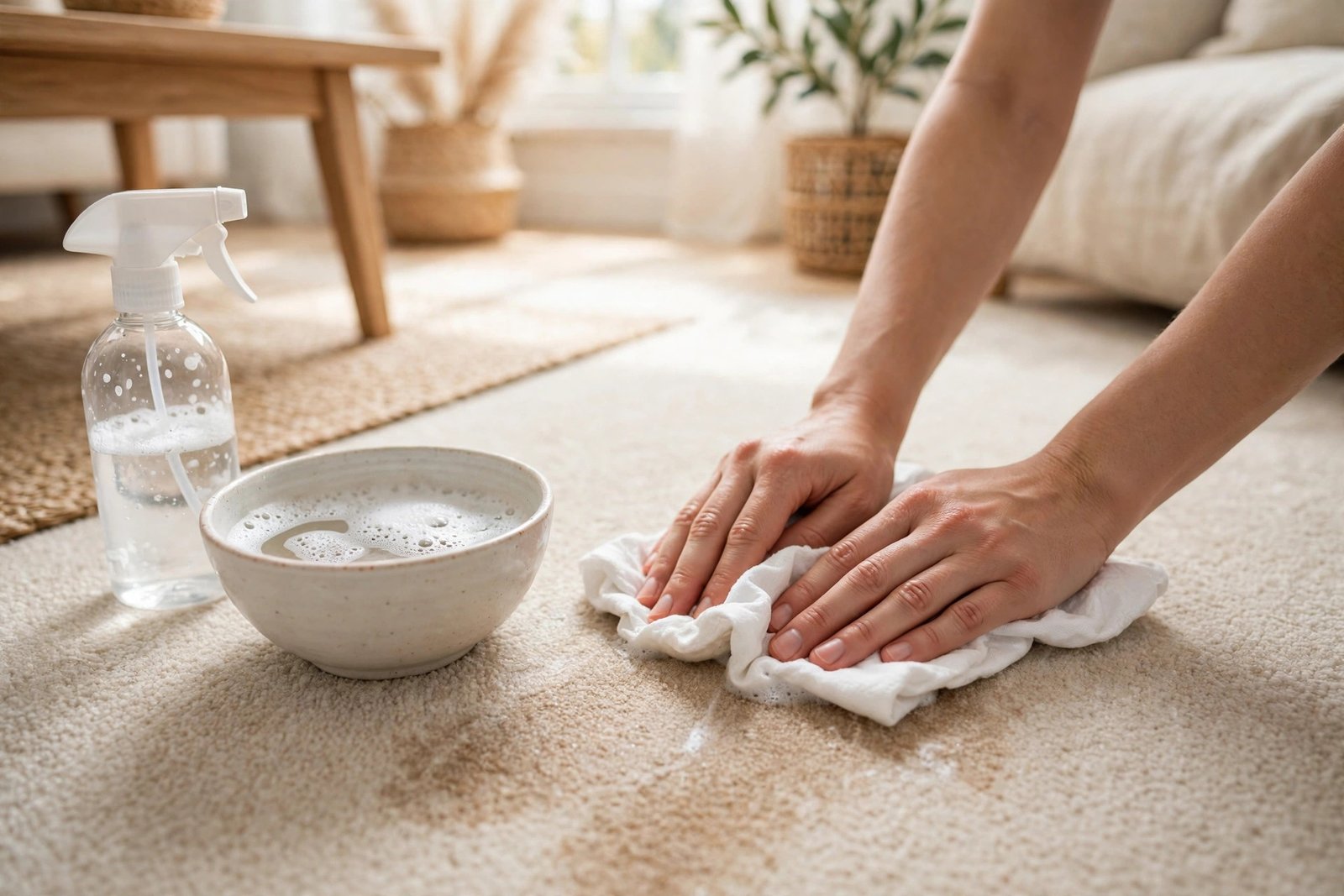
- Mix the solution — 1 tablespoon clear dish soap in 2 cups cold water.
- Blot the solution on with a cloth, working from the outside edge toward the center. Don’t pour, don’t scrub, don’t soak.
- Wait 5–10 minutes, then blot with a dry cloth. Repeat the apply–wait–blot cycle until the cloth comes away clean.
- Rinse by blotting with plain cold water.
- Dry under weight — a stack of white paper towels pressed down with something heavy for 2–4 hours, then vacuum.
| Stain | First move | Solution | Watch out for |
|---|---|---|---|
| Red wine | Blot, cover with salt if you can’t treat now | Dish-soap solution | Never use white wine “to neutralize” — it just adds liquid |
| Coffee | Blot fast, treat from edges | Dish-soap solution | Heat from earlier cleaning attempts can set it |
| Grease/oil | Scrape, blot | Dish soap, undiluted drop first | Rinsing alone does nothing — needs the soap |
| Pet urine | Blot or extract as much as possible | Enzyme cleaner | Soap first can lock in odor — enzyme goes first |
| Blood | Cold water blot only, at first | Cold water, then soap solution | Hot water cooks it in permanently |
| Mud | Let it dry completely | Vacuum, then soap solution | Treating wet mud spreads it |
| Old/unknown | Damp-cloth rehydration | Soap solution, multiple rounds | Set expectations — see the last section |
What You’ll Need
- Clean white cloths or white paper towels (colored towels can bleed dye onto wet carpet)
- A spoon or old credit card
- Clear dish soap — the plain, dye-free kind
- Cold water and a spray bottle or small bowl
- White vinegar (for a couple of specific jobs below)
- Baking soda (for odor-prone spots)
- An enzyme cleaner if you have pets — not optional in that case, it’s the main tool
- 3% hydrogen peroxide only for light-colored, synthetic carpet, and only after a hidden test (details in the wine and blood sections)
- Something flat and heavy — a stack of books works
Safety note before anything else: use one cleaner at a time, and never mix products — especially never combine bleach with vinegar or ammonia, which creates dangerous gases. Honestly, you don’t need bleach for anything in this guide. If a stain seems to demand it, that’s usually a sign to call a professional instead.
The Universal Method, Step by Step
Step 1: Get the excess off — 1 minute
Solids first. Scoop up anything sitting on the surface with a spoon, lifting upward so you don’t push it between fibers. For liquids, fold a white cloth, press it straight down on the spill, and lift. Rotate to a clean part of the cloth and repeat. You’re lifting the spill out, not moving it around. The Carpet and Rug Institute’s spot-removal guide starts exactly here, and their reasoning matches my experience: most of a fresh spill is still sitting on the carpet in the first minutes, and this is the cheapest removal you’ll ever do.
Step 2: Test your solution — 5 minutes (don’t skip this)
Whatever you’re about to use — including the mild soap solution — dab a little on a hidden area: inside a closet, under furniture. Wait 5 minutes, blot with a white cloth, and check two things: no color on the cloth, and no change to the carpet’s own color or texture. Most modern synthetic carpet passes easily. Wool, silk, and some dyed rugs do not — for those, stop at plain cold-water blotting and jump to the “when to call a pro” section of my main guide.
Step 3: Apply and blot — the working cycle
Dampen a white cloth in the soap solution (1 tablespoon clear dish soap to 2 cups cold water — measured, not glugged). Press it onto the stain, starting at the outer edge and moving inward. Hold for 20–30 seconds, lift, check the cloth — you should see the stain transferring. Move to a clean section of cloth and repeat. Fresh stains usually need 3–6 cycles; dried ones can take a dozen. If the cloth stops picking up color but the stain is still visible, re-dampen and give it a 10-minute rest before the next round. Dwell time does quiet work that your arm can’t.
Step 4: Rinse — the step that decides whether the spot comes back
Soap left in carpet is sticky, and sticky spots collect dirt until a gray shadow appears where the stain used to be. Blot the area repeatedly with a cloth dampened in plain cold water until the cloth no longer feels slippery. This feels like extra work. It’s actually the main event for how the spot looks in three weeks.
Step 5: Dry under pressure
Lay a stack of white paper towels about half an inch thick over the spot, put something heavy and flat on top, and leave it 2–4 hours or overnight. The towels wick up moisture — and with it, stain residue still hiding in the pile. Replace them if they’re soaked. When the carpet feels dry, vacuum to lift the fibers back up.
Per-Stain Fixes: Where the Universal Method Changes
Red wine. The diva of carpet stains, and honestly one of the more cooperative ones when fresh. Blot (don’t pour white wine on it — that trick just dilutes and spreads it), then run the universal method. If a pink shadow survives on light synthetic carpet, a hidden-tested dab of 3% hydrogen peroxide on a cotton swab can finish it — but walk away from peroxide entirely on wool or dark carpet. The full fresh-and-dried walkthrough.
Coffee. Speed matters most here because coffee’s tannins bond as it cools and dries. Same universal method; add a second rinse cycle, since coffee often carries milk and sugar that feed odor later. Stubborn coffee on light carpet responds to a solution of 1 tablespoon dish soap + 1 tablespoon white vinegar in 2 cups cold water. Detailed steps.
Grease and cooking oil. Water alone beads on grease. Put one drop of clear dish soap directly on the spot, work it in gently with your fingertip, wait 10 minutes, then blot with a cloth dampened in warm (not hot) water. Repeat until the greasy feel is gone. This same grease logic applies to clothes.
Pet urine. Different enemy — the problem is odor bacteria deep in the padding, not the visible spot. Blot up as much as possible first (stand on the towel — your weight extracts more than your hands). Then saturate the area with an enzyme cleaner, cover with a damp towel, and give it the hours the label asks for; enzymes work slowly or not at all if they dry out. Soap solution before the enzyme step can coat the urine and block the enzymes, so enzyme goes first here. Full method, including finding old spots.
Blood. Cold water is the entire secret at the start. Blot with a cloth soaked in plain cold water — no soap, no heat, nothing warm anywhere near it — until the transfer slows, then use the soap solution. Blood is a protein stain; hot water cooks it into the fibers permanently. (Same principle in the laundry version.)
Mud. The one stain where waiting is the technique. Let mud dry completely — an hour or two — then vacuum up the crumbled dirt, which removes most of it, and treat what’s left with the universal method. Everyone’s instinct to attack wet mud immediately is how a small footprint becomes a ground-in smear.
Old or unknown stains. Start by rehydrating: lay a cloth dampened with cold water over the spot for 15–20 minutes, then run the universal method in rounds, resting between them. Some old stains fade to nearly nothing; some — especially mystery stains in rentals that may have been “cleaned” with the wrong product before you — only lighten. My honest grading of what’s realistic is in the main guide.
Mistakes That Make Carpet Stains Permanent
- Scrubbing in circles. It frays the pile into a fuzzy patch that reads as a stain forever, even after the color is gone.
- Drowning the spot. Over-wetting pushes the spill through the backing into the padding — the setup for stains that mysteriously return days later (wicking).
- Using hot water first. Sets protein stains and can set tannin stains. Cold is the default.
- Mixing or stacking cleaners. Vinegar on top of a store spray on top of soap, without rinsing between, is ineffective at best. One product, rinse, reassess.
- Skipping the rinse. Leftover solution = future dirt magnet.
- Using colored cloths, newspaper, or printed towels on a wet stain. Dye transfer onto wet carpet is real; white only.
- Steam-cleaning a stain you haven’t treated. The heat can set it before extraction. Treat first, machine later if needed.
Honest Results From My Own Carpet
Full disclosure on what “works” means. Fresh coffee, wine, food spills: the universal method has taken out every one I’ve tried it on, usually in under 20 minutes. Dried pet stains: the enzyme route fixed the smell in our hallway after two applications — one application was not enough, whatever the bottle implies. A mystery gray-brown stain in a rental we moved into: four rounds over two days lightened it maybe 60%, and I called that done. And the original coffee-versus-cream-carpet incident from my main guide stayed visible for years because of my scrubbing, not because the stain was special. Technique is the product. The soap is almost a supporting actor.
For stain problems beyond carpet, the system widens here — and for keeping the whole house from reaching emergency status in the first place, the routine that runs my home is here.
Sources
The Carpet and Rug Institute publishes the most careful carpet spot-removal guidance I’ve found — manufacturer-neutral, big on testing and blotting, short on hype. Their residue and rinse advice shaped steps 4–5 above: Carpet and Rug Institute — Dry Type Residues spot guide, and their general stain walkthroughs, e.g. Carpet and Rug Institute — Kool-Aid spot removal, use the same outside-in blotting sequence this guide teaches.
FAQ
What is the best homemade carpet stain remover?
The one used in this guide: 1 tablespoon clear dish soap in 2 cups cold water. It handles most fresh food, drink, and general stains because dish soap is a strong surfactant — it lifts both grease and water-based grime. For pet stains, an enzyme cleaner beats any homemade mix.
Can I use hydrogen peroxide on carpet stains?
Only carefully. 3% hydrogen peroxide can finish off light stains on light-colored synthetic carpet, but it can bleach the dye out of darker carpets and damage wool. Hidden test first, cotton swab application, and skip it entirely if the carpet is wool, silk, or a color you’d grieve.
Why does my carpet stain keep coming back?
Wicking. The spill reached the carpet backing or padding; you cleaned the surface fibers; then as everything dried, the hidden stain wicked back up. Prevention is restraint with water during cleaning, plus the weighted paper-towel drying step. For a returning stain, repeat the method with even less liquid and a longer weighted dry.
How do I get a stain out of carpet without a machine?
That’s exactly what this guide is — cloths, soap solution, and patience replace a machine for most spots. Machines earn their keep for whole-room cleaning and large or repeatedly-returning stains, not single spots.
Will dish soap damage my carpet?
Diluted as directed and rinsed out, it’s one of the safest things you can use on synthetic carpet. The damage stories come from using too much, too strong, and leaving it in. Test first, measure, rinse — in that order.
How long should I wait before walking on the cleaned spot?
Until it’s fully dry — typically 2–4 hours with the weighted towels, longer in humid weather. Walking on damp pile grinds in fresh dirt and can re-spread a loosened stain. A fan pointed at the spot cuts the wait noticeably.
Written by Daniel Brown — home-tested methods, honest results. If your stain is on clothes instead, start with the laundry pillar. Last updated October 2026.