
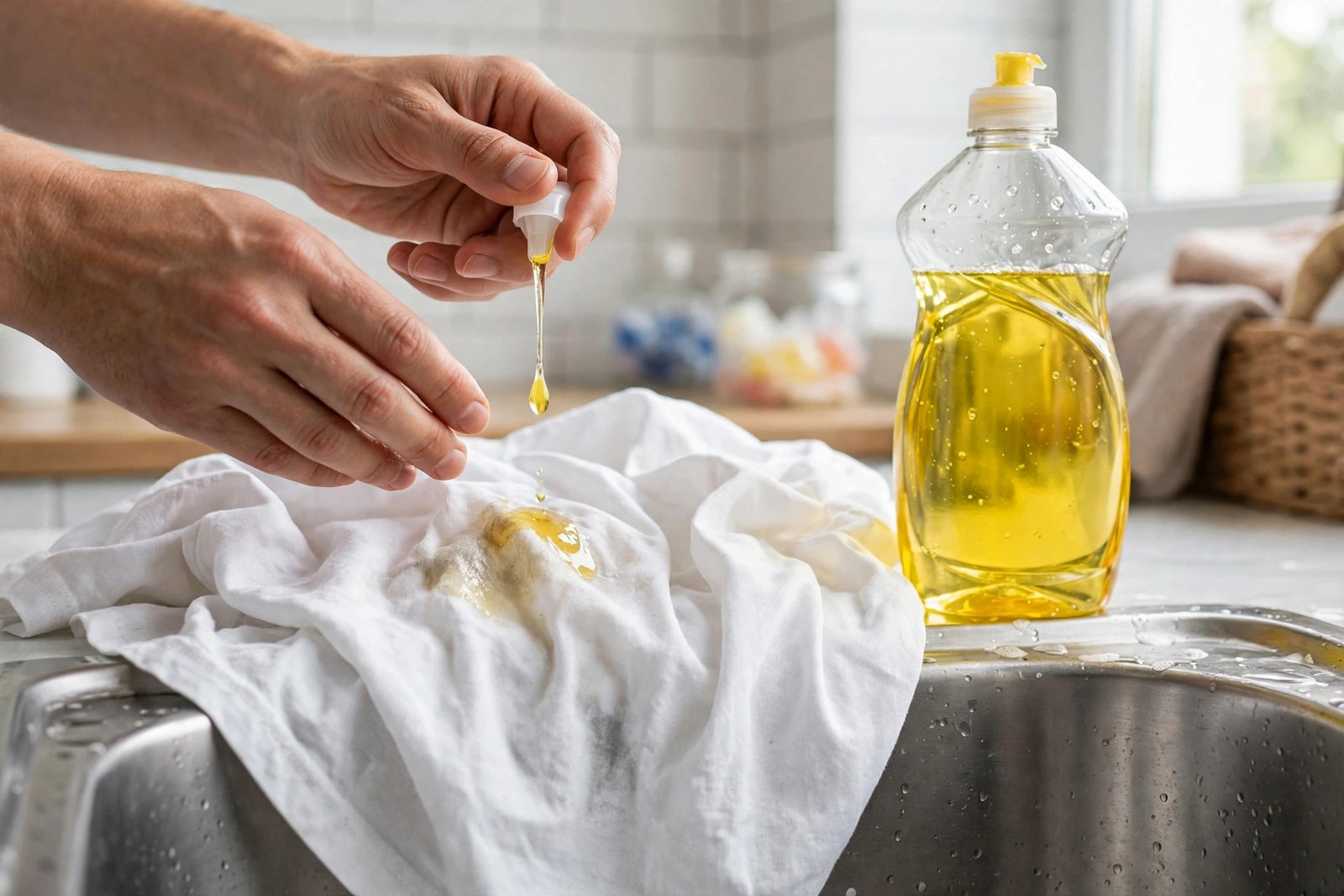
Grease stains lie to you. The shirt comes out of the wash looking fine, you fold it, and a week later there’s a dark shadow down the front that wasn’t visible when the fabric was wet. I’ve lost count of the shirts I’ve “saved” too early — including one good work shirt I ruined for real by tossing it in the dryer before checking.
So here’s the honest version up front: a fresh grease stain on clothes is one of the easiest stains to remove — dish soap genuinely works — and even a washed-in stain usually comes out with the baking soda and dish soap rescue below. The one unforgivable move is the dryer. Heat is what turns a treatable stain into a permanent one. This is part of my bigger laundry playbook in How to Get Stains Out of Clothes.
The Quick Answer
| Situation | Method | Sit time | Odds |
|---|---|---|---|
| Fresh grease (minutes old) | Blot, cover with baking soda or chalk, then dish soap | 15–30 min for the powder | Excellent |
| Washed, but air-dried only | Dish soap worked in well, then rewash | 10–15 min | Very good |
| Washed AND tumble-dried | Baking soda + dish soap paste, long sit, rewash, repeat | 30 min–several hours | Fair — may take 2–3 rounds |
| Silk, wool, “dry clean only” | Blot, dust with cornstarch only | 30 min | Take it to a cleaner and point out the spot |
What You’ll Need
- Liquid dish soap — the clear, degreasing kind. This is the whole ballgame: dish soap is literally engineered to cut grease.
- Baking soda or cornstarch (about 2–3 tablespoons per stain)
- Plain white chalk — optional, surprisingly good on small fresh splatters
- An old soft toothbrush or your fingertips
- A piece of cardboard or an old towel, to slip behind the stain
- Your regular laundry detergent
- A basin or sink for soaking
Fresh Grease: The 30-Minute Fix
Step 1: Lift the excess, don’t spread it
Scrape off any glob with a dull knife edge, then blot gently with a paper towel. Rubbing at this stage just drives oil sideways into clean fabric. Work fast if you can, but don’t panic — a grease stain you treat tonight is still a fresh stain.
Step 2: Let a powder drink the oil
Cover the stain completely with baking soda or cornstarch, pat it down lightly, and leave it 15–30 minutes. The powder turns translucent and clumpy as it pulls oil out of the fibers — that’s the stain leaving early. For a small cooking splatter, plain white chalk rubbed over the spot does the same job. Brush the powder off into the trash, and if the first layer came away soaked and dark, do a second round. Pizza spots on cotton often need two.
Step 3: Work in the dish soap
Lay the garment flat with cardboard behind the stain so nothing transfers through. Put a few drops of dish soap directly on the spot and work it in with your fingers or the soft toothbrush for about a minute, until it lathers slightly. Let it sit 5–10 minutes. The University of Georgia Extension’s oil stain guide gives the same core advice for oily stains on apparel — pretest what you use, follow the care label — and dish soap is the home version of it: attack the oil, not just the color.
Step 4: Rinse from the back, then wash
Rinse the spot under warm running water from the back of the fabric, so the water pushes the grease out the way it came in. Then wash the garment as usual, in the warmest water the care label allows, with your regular detergent. Persil’s own oil stain removal guide recommends the same order — pretreat, wash, and check before drying.
Step 5: Air-dry and inspect in daylight
Hang it up. Do not put it in the dryer. When it’s dry, look at the spot in bright light, ideally near a window. Gone? It can go in the dryer next time. Still there? Move to the rescue below — every option is still open because you skipped the heat.
Already Washed (and Maybe Dried)? The Rescue Routine
No false promises here: a grease stain that has been through the dryer is the hardest version of this stain. Not hopeless — just slower.
- Find the whole stain. Put the dry garment flat in good light — dried-in grease usually covers more area than you remember. Chalk-mark the edges if it helps.
- Powder first, even now. Cover the stain with baking soda and leave it at least 30 minutes — overnight doesn’t hurt. Old oil still migrates into the powder, just slowly.
- Make a paste. Brush off the powder, then work a paste of baking soda and a few drops of dish soap into the stain with the toothbrush. Add drops of warm water until it’s toothpaste-thick.
- Give it real time. Let the paste sit 30 minutes minimum; for a dryer-set stain I leave it 2–3 hours. Keep it from drying out completely — lay a damp cloth over it if your laundry room runs warm.
- Soak, then wash. Soak the garment 30 minutes in a basin of warm water with a tablespoon of laundry detergent, paste and all. Then machine wash on the warmest setting the label allows.
- Air-dry and judge in daylight. One round fades most set-in stains; a second removes most of what’s left. Two rounds is normal, not failure.
What I don’t recommend for the rescue: chlorine bleach (hard on colors and fibers, no special power over oil), solvent tricks like gasoline (a fire hazard, full stop), and scrubbing harder. Time and dish soap beat force every time.
Fabric Cautions Worth 30 Seconds
- Silk and wool: blot, dust with cornstarch for 30 minutes, brush off. Skip dish soap and brushing — both can damage these fibers. Anything you care about goes to a dry cleaner; tell them it’s grease, and where.
- “Dry clean only” means it. Water-based treatment on structured or dry-clean-only garments can leave rings worse than the stain.
- Dark and bright colors: use clear dish soap, not the blue or green kind, and test on an inside seam first — colored soaps can tint some fabrics, and some dyes bleed under any soap.
- Synthetics (polyester, workout gear): polyester holds onto oil more stubbornly than cotton — the powder step and a longer dish-soap sit (15 minutes) make a real difference here.
What NOT to Do
- Don’t tumble-dry a stain you haven’t checked. This is the whole sermon. Dryer heat bonds oil into the fiber. A stain can survive three washes and still come out — it rarely survives the dryer unchanged.
- Don’t rub a fresh grease spot. Blot and lift. Rubbing spreads the oil and pushes it deeper.
- Don’t use hot water to rinse a fresh stain before treating it. Powder and soap first; warm water belongs to the wash step, once the soap is on the job.
- Don’t use chlorine bleach on colors or as a first resort. It’s the wrong tool for oil and the wrong risk for fabric.
- Don’t layer products. If you tried a commercial stain remover and it didn’t finish the job, rinse the garment before switching to the dish soap method. Mixing laundry chemicals is never the answer.
My Honest Results
Fresh splatters — bacon, salad dressing, the mystery spot from grilling — come out in one wash after this routine, essentially every time. Washed-but-air-dried stains: one rescue round, sometimes two. Dryer casualties are where I’ll be straight with you: my success rate is maybe two out of three, and the failures share a pattern — dark, old stains on synthetics dried more than once. If a stain survives two full rescue rounds on a shirt you love, a dry cleaner’s solvent treatment beats a third round at the sink.
Safety note: Always check the garment’s care label before treating, and spot-test dish soap on a hidden seam on delicate or richly colored fabric. Keep stain treatments away from kids, and never mix bleach with any other cleaner — including vinegar or ammonia — because the fumes are genuinely dangerous.
FAQ
Can you get a grease stain out after it has been washed and dried?
Often, yes — but set expectations. The baking soda and dish soap paste, left on for a few hours, followed by a warm soak and wash, removes or heavily fades most dryer-set grease in 1–3 rounds. Very old stains on polyester may only fade. Never re-dry between rounds; air-dry and check each time.
Does dish soap really work better than laundry stain removers?
For grease specifically, it’s at least their equal — dish soap is formulated to emulsify cooking oil, which is exactly what’s in the fabric. Enzyme pretreaters are a fine alternative, and better for mixed stains like gravy (part oil, part protein). For pure oil, dish soap is what I grab first.
Will baking soda alone remove a grease stain?
On a fresh stain, it removes a surprising amount — the powder pulls oil out of the fibers before washing. But it’s a first step, not the whole treatment. The dish soap step afterward is what breaks down the oil film the powder can’t reach.
What about motor oil and bike-chain grease?
Same routine, lower expectations. Treat it as a set-in stain from the start (powder, paste, long sit, warm wash), wear gloves, and wash the garment alone the first time — heavy petroleum grease can gray other clothes in a shared load.
Why did the stain look gone when wet but come back when dry?
Water darkens fabric evenly, which camouflages the grease shadow; as the fabric dries, the oil patch shows again — oil dries differently and holds dirt differently. That’s why the check happens after air-drying, in daylight.
By Daniel Brown — grease is the stain I know best, mostly from cooking in clothes I shouldn’t have cooked in. For the rest of the laundry room, see the Complete Stain Removal Guide and Blood Stains on Clothes and Mattress — that one plays by completely different rules (cold water only).