
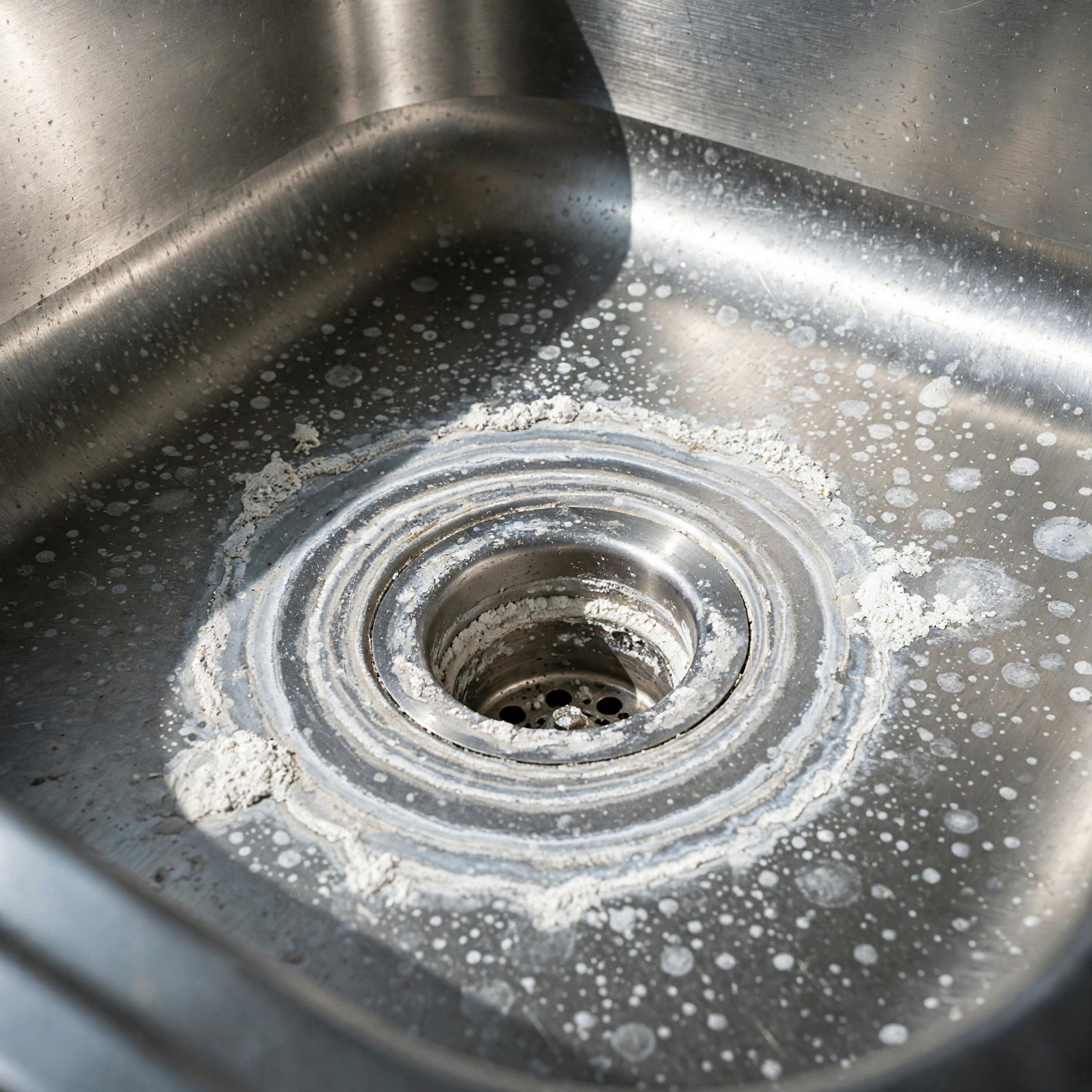

A stainless steel sink is supposed to be the easiest thing in the kitchen to keep clean. So why does yours look cloudy and spotty no matter how often you scrub it?
Because most of the marks on a stainless sink aren’t dirt. They’re mineral deposits from hard water, a film of soap scum, rust transferred from something sitting wet in the basin, and scuffs from cookware — and each one needs a different fix. The good news: every one of those marks comes off with things you already own, as long as you match the method to the mark and work with the grain of the steel.
Key Takeaways
How to clean a stainless steel sink: first identify the mark — chalky white spots are hard-water minerals, a draggy haze is soap film, orange spots are rust transferred from iron sitting wet in the basin, and gray streaks are scuffs from cookware. Dissolve mineral spots with a vinegar compress for 5 to 10 minutes, lift soap film with a baking soda paste, and use a gentle oxalic-acid cleanser only for stubborn rust. Always scrub with the grain, never in circles, and dry the sink after every use.
Table of Contents
- What Kind of Mark Is It?
- What You Need
- Step 1: The 60-Second Daily Wash
- Step 2: Dissolve Hard Water Spots With Vinegar
- Step 3: Lift Soap Film and Dull Haze With Baking Soda
- Step 4: Stubborn Rust — the Oxalic-Acid Step
- Step 5: Scuffs and the Drain and Faucet Base
- If Your Sink Is Coated or Colored
- What NOT to Do
- The Weekly Sink Reset
- For Further Reading
- FAQ
- The Bottom Line
What Kind of Mark Is It?
Before you reach for anything, look at the sink in good light and figure out what you’re dealing with. Guessing wrong is how people scratch a sink trying to polish off a mineral deposit.
| Mark | What it looks like | What it is | First move |
|---|---|---|---|
| Hard water spots | Chalky white dots or rings | Calcium and magnesium left when water evaporates | Vinegar compress (Step 2) |
| Soap film | A dull, draggy haze | Soap and cleaner residue building up over weeks | Baking soda paste (Step 3) |
| Rust-colored spots | Orange or brown specks, often where something sat | Iron from a pan, can, or steel wool left wet | Oxalic-acid cleanser (Step 4) |
| Gray scuffs | Thin dark streaks on the basin floor | Metal from aluminum pans or rubber feet | Baking soda paste (Step 5) |
| Rainbow or blue tint | A faint oily sheen | Thin mineral or soap film; rarely heat tint | Vinegar compress, then soap wash |
One quick test helps: scrape a spot gently with your fingernail. If it feels raised, it’s a deposit sitting on top of the steel — dissolve it, don’t scrub it. If it feels flat, it’s a transfer mark or a film, and a gentle abrasive step is the right call. And one thing worth knowing: stainless steel isn’t stain-proof. The name really means it stains less — a thin layer of chromium oxide is what keeps it from rusting, and harsh cleaners and steel wool are what damage that layer.
What You Need
You probably own all of this already: microfiber cloths, a non-scratch sponge, dish soap, white vinegar, and baking soda. For the stubborn step only, a gentle oxalic-acid cleanser — the kind sold as a powder or cream for stainless steel. An old soft toothbrush helps for the drain and faucet base. Skip steel wool, scouring pads, bleach, and oven cleaner — all four can scratch or pit the finish.
Step 1: The 60-Second Daily Wash
Start with the simplest step, because half the time it’s all the sink needs. Rinse the basin with warm water, add a drop of dish soap to a damp non-scratch sponge, and wipe the whole sink — basin, walls, rim, and around the faucet base — always moving with the grain. Then rinse well and dry it with a microfiber cloth.
Drying is the step everyone skips, and it’s the step that matters most. Hard water can’t leave a spot if the water never sits there long enough to evaporate.
Step 2: Dissolve Hard Water Spots With Vinegar
Hard water spots are mineral deposits, and minerals dissolve in mild acid. Think of this step as melting the spot off instead of sanding it off.
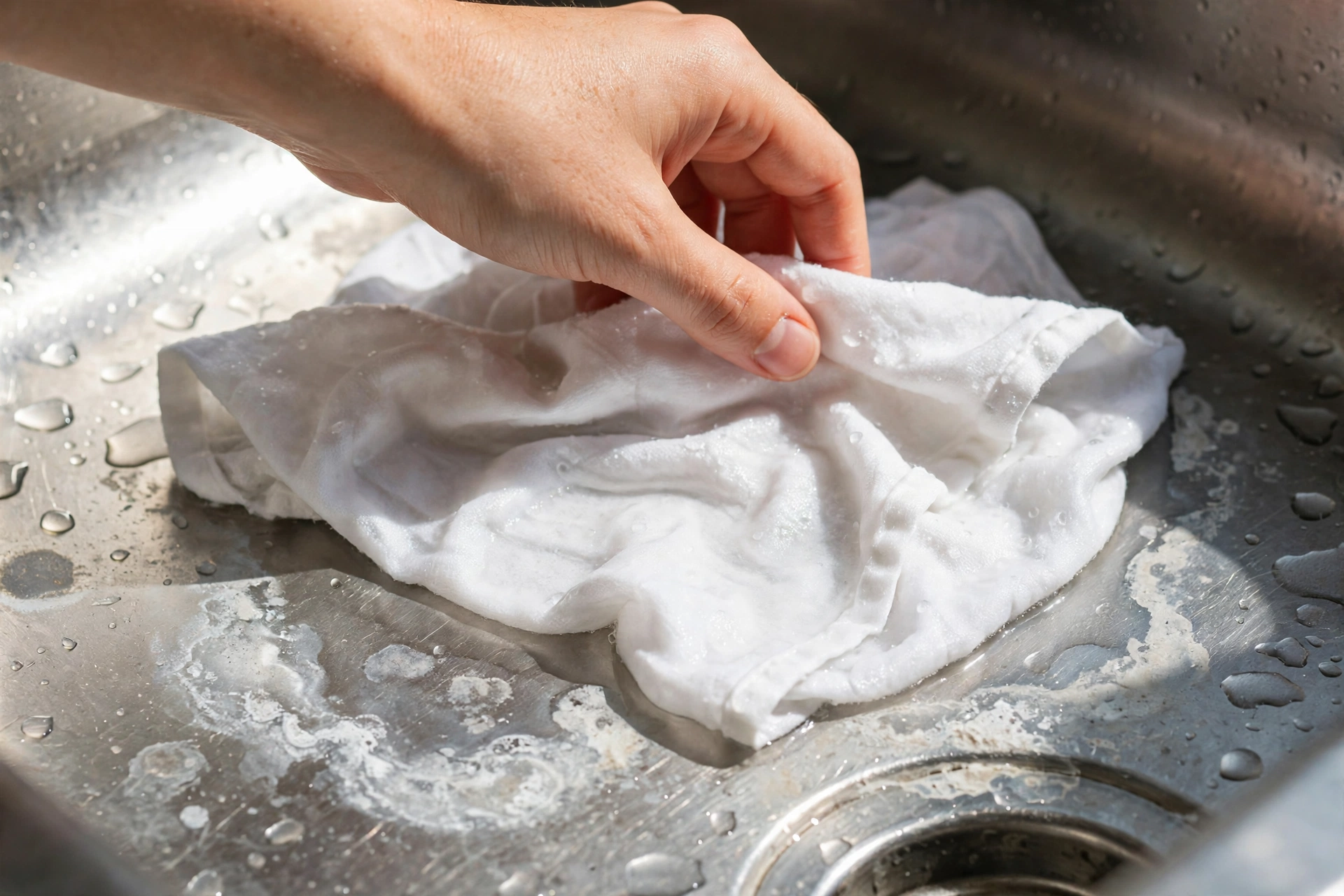
- Rinse the sink and lightly dry it, so the vinegar isn’t diluted by standing water.
- Soak a paper towel or cloth in undiluted white vinegar and lay it over the spotted area, or wrap it around the faucet base or drain flange.
- Leave it for 5 to 10 minutes. Light film usually loosens in five; a heavy crust may need the full ten.
- Remove the cloth, wipe with the grain, rinse thoroughly, and dry completely.
If the spots are very heavy, repeat the compress rather than leaving one soak on for hours — long acid contact is what dulls a finish. A citric acid solution works the same way: dissolve a teaspoon in a cup of warm water and use it in place of the vinegar. If your sink has a coated finish, skip the acid entirely and jump to the coated-finishes section below.
Step 3: Lift Soap Film and Dull Haze With Baking Soda
If the sink looks clean after the vinegar step but still feels dull, that’s soap film — the thin layer of soap and cleaner residue that builds up over weeks. Sprinkle baking soda generously over the damp basin, walls included. Mist it lightly with water until it forms a paste, then rub it gently with a non-scratch sponge, always with the grain. Rinse well and dry — the steel looks brighter right away.
Step 4: Stubborn Rust — the Oxalic-Acid Step
Orange spots that survive the vinegar and baking soda steps are almost always transfer rust — iron from a cast iron pan, a steel can, or a fragment of steel wool that sat wet in the basin. The steel itself isn’t rusting.
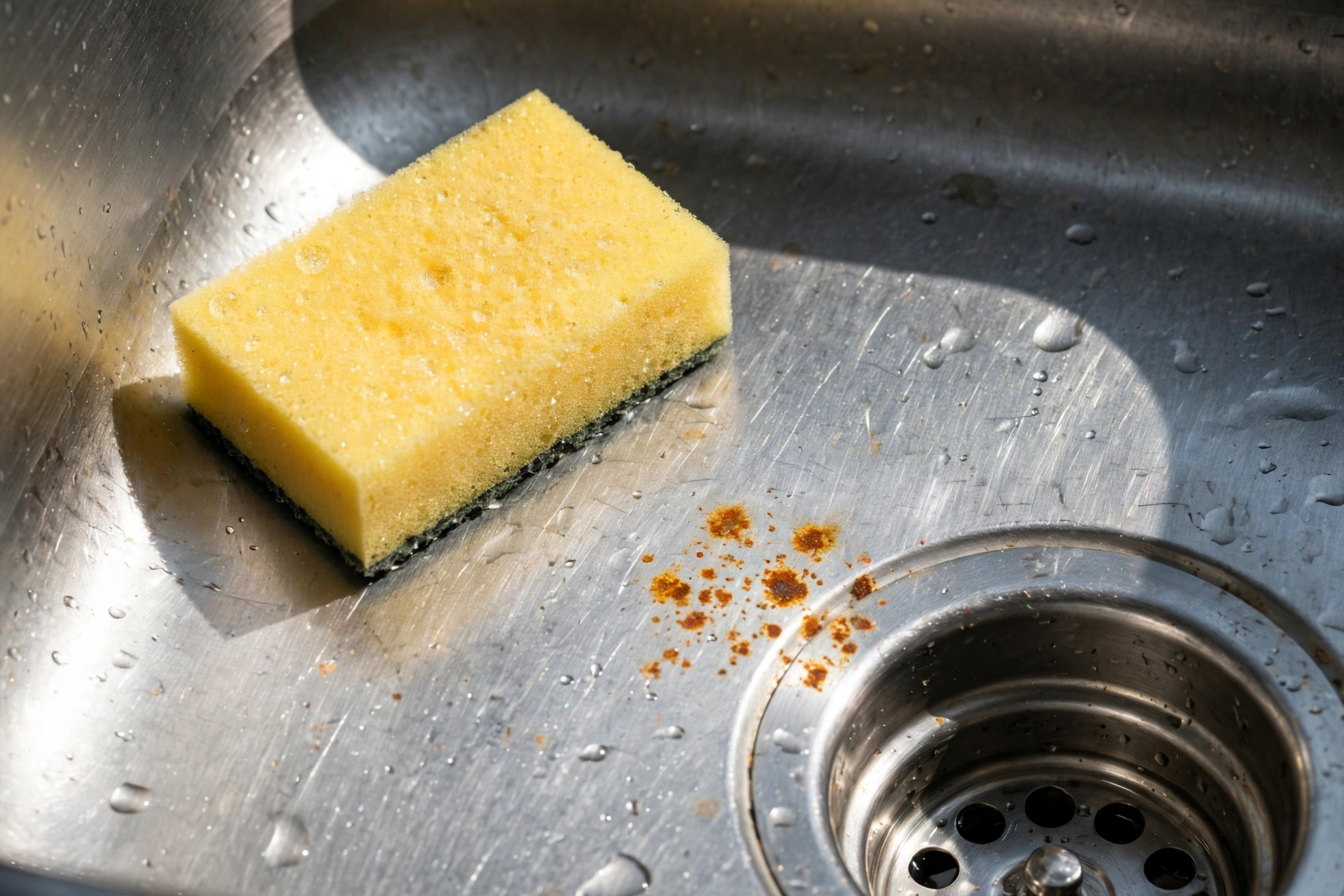
This is the one step that uses a real chemical cleaner. Oxalic acid locks iron and mineral deposits into a form that rinses away. Use it sparingly and follow the label: wet the sink first, sprinkle a small amount onto a damp non-scratch sponge (not directly onto the dry steel), rub with the grain using light pressure in small sections, then rinse very well and dry and buff with a clean microfiber cloth.
Three cautions: never mix this kind of cleanser with bleach or ammonia; never let it dry on the steel; and spot test first if your sink has an unknown finish or you’re in a rental. If the orange spots keep coming back, the cause is still in your sink — check for a pan, can, or metal scrubber left in the basin.
Step 5: Scuffs and the Drain and Faucet Base
Gray scuffs from aluminum pans or rubber drying-rack feet usually lift with the baking soda paste from Step 3. If a scuff survives that, a gentle pass with the oxalic-acid cleanser, with the grain and light pressure, usually finishes it. Deep scratches are a different matter — only a refinishing kit or a professional can change them.
The drain and faucet base are where spots hide. The drain flange collects mineral rings; the faucet base collects water that drips down and evaporates. Wrap a vinegar-soaked cloth around the faucet base for 10 to 15 minutes, and use an old soft toothbrush around the drain flange and the aerator.
If Your Sink Is Coated or Colored
Not every modern sink is bare stainless. Matte black, graphite, and other coated finishes look sleek, but they’re far less forgiving with acids and abrasives. If you’re not sure what you have, assume it’s coated and go gentle. Warm water, dish soap, and a soft cloth are the whole method. For mineral spots, try plain water first, then a tiny amount of vinegar on a cloth only if the manufacturer allows it, rinsing immediately. Skip baking soda pastes and oxalic-acid cleansers unless the sink maker explicitly says they’re safe.
What NOT to Do
Most sink damage is self-inflicted, and it’s almost always one of these:
- Don’t use steel wool or wire brushes. They scratch the finish and leave iron particles that rust later.
- Don’t use green scouring pads. They’re too abrasive for brushed stainless.
- Don’t use chlorine bleach or chloride cleaners. Chlorides can pit stainless steel.
- Don’t scrub in circles. Circular scrubbing creates visible swirls. Always move with the grain.
- Don’t let cleaners dry on the sink. Dried product leaves its own residue and uneven sheen.
- Don’t leave metal sitting wet in the basin. Pans, cans, and scrubbers are the usual source of transfer rust.
The Weekly Sink Reset
A clean sink stays clean with a short weekly routine: 2 minutes for a soap wash, rinse, and dry; 5 to 10 minutes for a vinegar compress on any spots while you wipe the counters; 1 minute to wipe with the grain, rinse, dry, and buff. For a final shine, wipe a drop of mineral oil over the dry steel. If your water is hard, the nightly 30-second dry-down from Step 1 is the habit that matters most.
For Further Reading
- How to Remove Hard Water Stains From Glass Shower Doors — the same method on glass, including the etched-glass trap no cleaner can fix.
- How to Clean Bathroom Grout — the bathroom sibling for grout lines.
- How to Get Rid of Garbage Disposal Smell — the drain side of the same sink.
- How to Get Rid of Dishwasher Smell — the same lesson: the daily habit beats the deep clean.
FAQ
Can I use vinegar on a stainless steel sink every day?
You can, but you don’t need to. A daily soap wash and dry-down prevents spots from forming; vinegar is for the spots already there. Rinse and dry afterward if you use it.
Will baking soda scratch my sink?
Not if you use it as a paste with a non-scratch sponge and move with the grain. What scratches a sink is steel wool, scouring pads, and circular scrubbing — not baking soda.
Why do orange spots keep coming back?
Because the source is still there. Orange spots are almost always transfer rust from something sitting wet in the basin — a pan, a can, or a metal scrubber. Remove the source, clean the spots with the oxalic-acid step, and dry the sink after use.
How do I find the grain direction?
Look closely under good light — you’ll see fine, consistent lines in the metal. Or run a damp cloth lightly in one direction, then the other: one direction feels smoother, and that’s with the grain.
My sink is matte black. Can I use this method?
No — not the acid or abrasive steps. Coated finishes need warm water, dish soap, and a soft cloth only, with vinegar only if the manufacturer allows it.
The Bottom Line
I’ll be honest: for years I treated a spotty sink as a scrubbing problem, and I made it worse — swirl marks on top of water spots. The fix turned out to be the opposite of scrubbing harder. Identify the mark, dissolve it instead of sanding it off, move with the grain, and dry the sink when you’re done. Five minutes of the right method, once a week, and a thirty-second dry-down at night, is all it takes.


