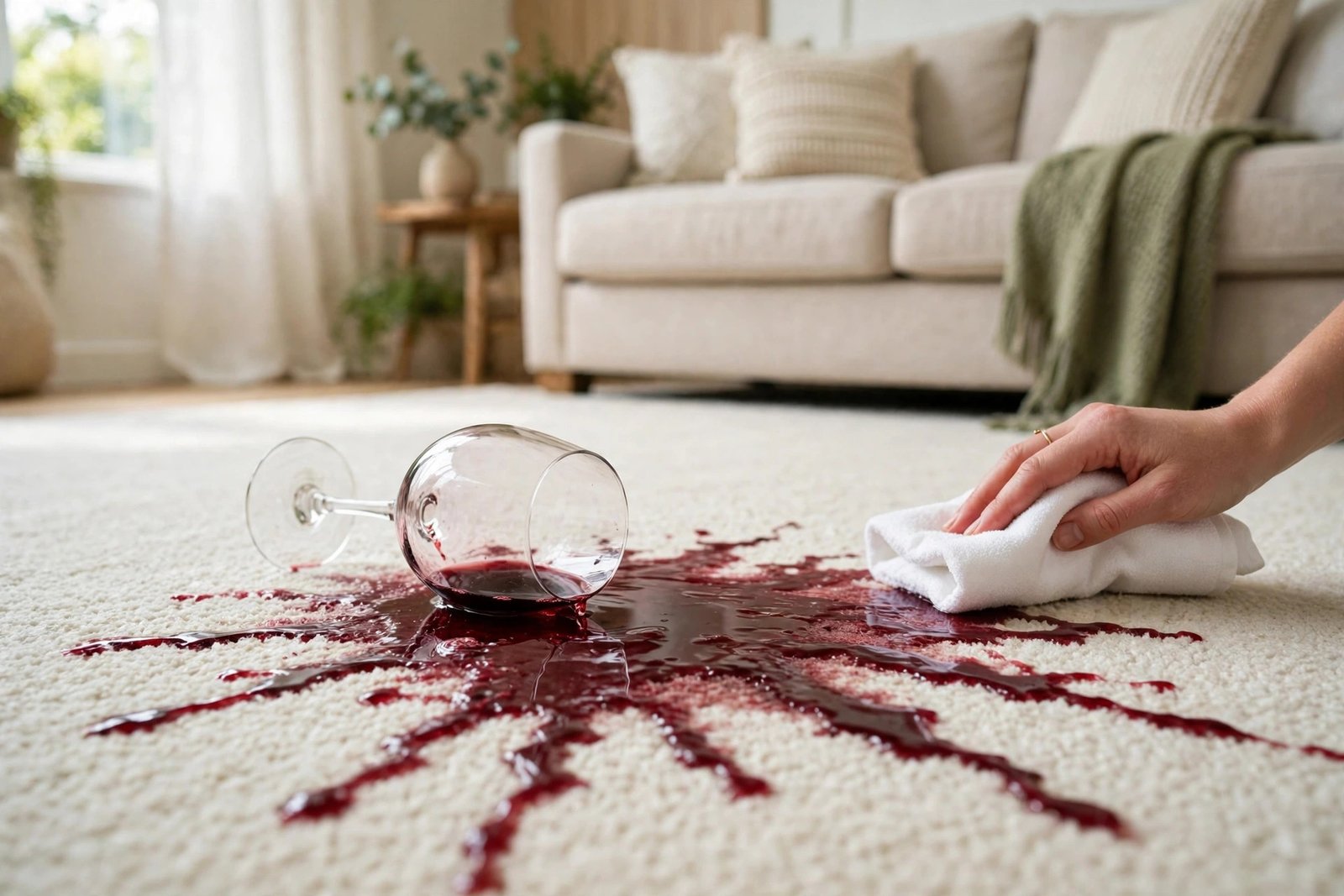
The glass went over at my sister’s house, on a rental carpet that was about two shades lighter than any carpet should ever be. Nobody moved for a second. Then everyone moved at once, and three different people reached for three different “remedies” they’d heard somewhere.
Here’s what actually worked, and it’s the same order I use at home: blot first, cover the spill with salt or baking soda while it’s still wet, then clean what’s left with a simple dish soap solution. That’s it. On a fresh spill, that sequence gets the red wine stain out of carpet completely in most cases. A dried stain takes one extra step — and one honest warning about peroxide, which I’ll get to below. If you want the bigger picture on carpet stains in general, my complete carpet stain guide covers every type, but for wine, start here.
The Quick Answer
| Situation | First move | Cleaning mix | Watch out for |
|---|---|---|---|
| Fresh spill (still wet) | Blot, then salt or baking soda for 15–20 min | 1 tbsp dish soap + 1 tbsp white vinegar in 2 cups cold water | Don’t scrub — it spreads the stain |
| Spill from last night (dried) | Re-wet with cold water first | 2 parts 3% hydrogen peroxide + 1 part dish soap | Peroxide can bleach dark carpet — test first |
| Wool or silk rug | Blot only, cold water | Mild detergent solution, no peroxide | Call a pro if the color doesn’t lift |
| White/cream synthetic carpet | Same as fresh | Peroxide mix is usually safe here | Still spot-test a hidden corner |
What You’ll Need
- Clean white cloths or plain white paper towels (white matters — a colored towel can transfer dye onto wet carpet)
- Table salt or baking soda, about ¼ cup for an average glass-sized spill
- Liquid dish soap (clear, without bleach)
- White vinegar
- Cold water, plus a spray bottle if you have one
- 3% hydrogen peroxide — only for the dried-stain method, and only after a spot test
- A vacuum
- A heavy book or pan, for the final drying step
Fresh Spill: The First 10 Minutes Matter Most
Step 1: Blot. Don’t wipe, don’t scrub.
Stand on a folded white cloth if the spill is big — your body weight pushes the wine out of the pile better than hand pressure. Work from the outside edge toward the center so you don’t push the stain wider. Keep swapping to a clean section of cloth. When a cloth comes up almost clean, you’ve got the surface liquid out. This takes 2–3 minutes, and it does more than any product you’ll use afterward.
Step 2: Bury it in salt or baking soda
While the spot is still damp, cover it completely — you shouldn’t see red through the pile. Salt pulls liquid up out of the fibers as it sits; baking soda does the same and helps with odor. Leave it 15–20 minutes. You’ll see the salt turn pink — that’s the wine leaving the carpet.
Don’t rush this step to vacuum at 5 minutes because guests are watching. A half-lifted stain that dries is tomorrow’s problem.
Step 3: Vacuum, then wash with the dish soap solution
Vacuum up the salt. Now mix 1 tablespoon dish soap and 1 tablespoon white vinegar in 2 cups of cold water. This ratio matches what the University of Illinois Extension recommends in its wine stain guide, and it’s the mix I’ve used ever since I stopped experimenting. Apply it with a cloth, a little at a time — don’t flood the carpet. Blot, check the cloth, repeat. Work in small sections and be patient; a dinner-glass spill usually takes 4–6 rounds of this.
Step 4: Rinse and dry properly
Dampen a clean cloth with plain cold water and blot the whole area to pull out the soap. Leftover soap residue attracts dirt, so the spot will look dirty again in two weeks if you skip this. Then lay a thick stack of white paper towels over the spot, weigh it down with a heavy book, and leave it for a few hours or overnight. The towels wick out what’s deep in the pad.
What about club soda?
Honest verdict: club soda is fine, but it’s not magic. It’s mostly cold water with fizz, and the cold water is doing the real work — diluting the wine and keeping it from setting while you blot. If a bottle is in your hand when the spill happens, use it. If it’s in the store and the wine is on your carpet, do not leave to go buy it — plain cold water performs nearly as well.
Dried Red Wine Stain: The Peroxide Method (With a Real Warning)
Found the stain the next morning? It’s harder, not hopeless. Dry pigment doesn’t lift, so the first job is getting the spot wet again.
Step 1: Re-wet the stain
Spray or dab cold water over the whole stain until the fibers are damp through. Blot once. You’ll see some color come up even now.
Step 2: Mix the peroxide solution — and test before you commit
Mix 2 parts 3% hydrogen peroxide with 1 part dish soap (½ cup peroxide + ¼ cup dish soap is plenty for a typical stain).
Now the warning, and I mean it: peroxide is a mild bleach. It can lighten dark-colored carpet permanently, and it can damage wool. The IICRC — the industry body that certifies carpet cleaners — says the same thing in its consumer carpet care tip sheet: peroxide works on wine, but bleaching around the spot can occur with natural fibers. So: dab the mix on a hidden area first — under the couch, inside a closet corner — wait 10 minutes, and blot with a white cloth. If the carpet’s own color comes off or the spot looks lighter, stop. Use the fresh-spill dish soap method instead, repeated patiently, or call a professional.
On light-colored synthetic carpet (most family-room carpet in the US), the peroxide mix is the single most effective home treatment I know for a dried wine stain.
Step 3: Apply, wait, blot
Pour or spoon the mix onto the stain — enough to dampen it, not soak the padding. Let it sit 20–30 minutes. Blot with a clean white cloth. The color should transfer. Repeat once if a shadow remains.
Step 4: Rinse and dry
Blot with a cloth dampened in plain cold water, several times, until no soap feel remains. (Peroxide itself breaks down into water and doesn’t need rinsing; the dish soap does.) Finish with the weighted paper-towel stack from Step 4 above and let it dry fully before walking on it.
What NOT to Do
- Don’t pour white wine on it. This is the most repeated myth in stain removal. The idea is that white wine “neutralizes” red — it doesn’t. It adds more liquid, more sugar, and a faint yellow tint of its own. Anything white wine appears to do, cold water does better and cleaner. Save the white wine for drinking.
- Don’t scrub. Scrubbing frays carpet fibers (that fuzzy, worn look never comes back out) and drives pigment deeper and wider. Blotting feels slower. It is faster.
- Don’t use hot water. Heat helps wine pigment bond to fibers. Everything in this guide is cold or lukewarm, on purpose.
- Don’t mix cleaners. Never combine peroxide with bleach or with vinegar in the same container, and never layer one chemical over another without rinsing in between. Pick one method, finish it, rinse — then switch if you must.
- Don’t reach for the steam cleaner. Steam is heat plus pressure — the two things that set this stain for good.
My Honest Results
On fresh spills, the salt + dish soap routine has never failed me on synthetic carpet; the spot is gone the same night and doesn’t ghost back later. The dried-stain peroxide method is genuinely strong, but I’ll be straight about its limits: on a dark red patterned rug at my parents’ place, I skipped it entirely — the risk of a light patch was worse than the stain, and two patient rounds of the detergent method faded the mark to “you have to know it’s there.” On wool, I don’t use peroxide at all. And if a stain survives two full rounds of treatment, more chemistry at home rarely fixes it — that’s the point where a professional hot-water extraction earns its money.
Safety note: Always spot-test any solution on a hidden area first, whatever the carpet. Check the manufacturer’s care instructions if you have them, wear gloves if your skin is sensitive, and keep peroxide and cleaning mixes away from kids and pets until the area is dry.
FAQ
Can you get red wine out of carpet the next day?
Yes — re-wet the dried stain with cold water first, then treat it. On light synthetic carpet, the peroxide and dish soap mix is the most reliable home method. Expect 2 rounds and about an hour, not the 10 minutes a fresh spill takes.
Does salt really remove red wine stains?
Salt doesn’t dissolve the stain; it absorbs the liquid carrying the pigment, pulling wine up out of the fibers while the spill is still wet. It works as a first step, not a complete treatment — you still need the dish soap wash afterward.
Will hydrogen peroxide ruin my carpet?
It can lighten dark dyes and damage wool or silk fibers. On light-colored synthetic carpet it’s generally safe, but spot-test a hidden area and wait 10 minutes before treating the stain itself. When in doubt, skip it.
What if the stain comes back after drying?
That’s wicking — wine that reached the carpet pad rising back up as it dries. Blot the spot, lightly mist with cold water (or 3% peroxide on light synthetic carpet only), and dry it again under a weighted stack of white towels. If it returns twice, the spill is in the pad and a professional extraction is the realistic fix.
Can I use this on a wool rug?
Use the blotting, salt, and detergent-solution steps only — no peroxide, no vinegar-heavy soaking. Wool is a natural fiber that both wine and bleach-type chemicals bind to stubbornly. For an expensive wool rug, a professional cleaner is worth it.
By Daniel Brown — I test every method in this guide at home before it goes on the site. See the full Complete Stain Removal Guide for every stain type, and if coffee is your usual culprit, read Coffee Stains on Carpet next.