
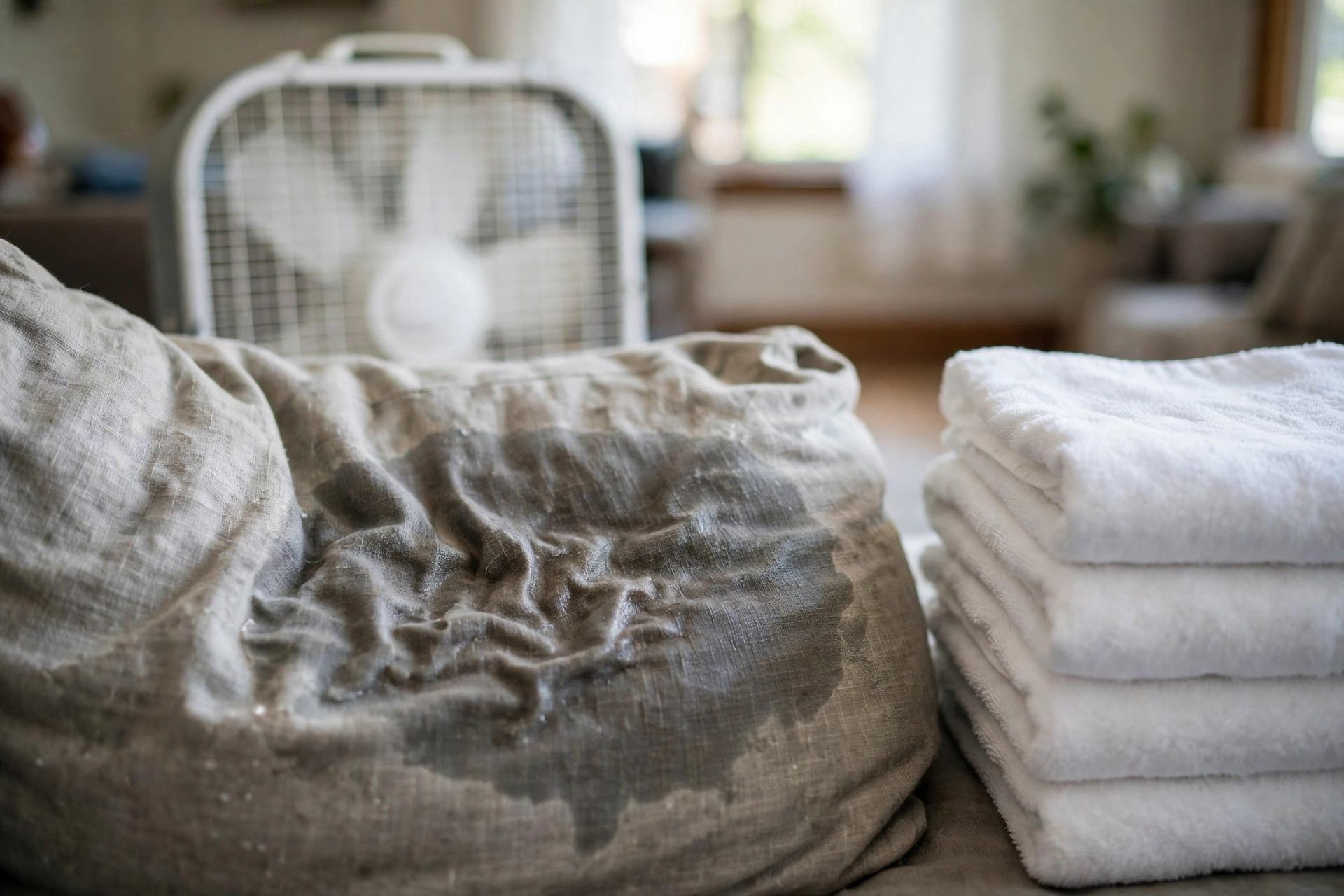

Key Takeaways
How to dry a wet couch: strip off the covers and cushions, blot up as much water as you can, pull the rest out with towels or a shop vac, stand the cushions on edge, and keep air moving across the foam until it is dry all the way through. Check it again tomorrow — a couch that feels dry on top can still be damp inside, and that is where mold starts.
A wet couch is one of those messes that feels worse than it looks. The surface might not even look that bad — a dark patch, maybe a ring — but the foam underneath is holding far more water than you think. Get it out fast and the couch is fine. Leave it, and you are dealing with mold, a musty smell, and a cushion that never sits right again.
The good news: most wet couches are completely saveable, and you probably already own everything you need. This is the fast way to dry one, in the order that actually matters.
Table of Contents
Jump to a step
- 1. First: How Wet Is It, Really?
- 2. Step 1: Strip It Down
- 3. How Long Will It Take? (Drying Times by Foam Type)
- 4. Which Method Fits Your Spill?
- 5. Step 2: Pull the Water Out
- 6. Step 3: Stand It on Edge
- 7. Step 4: Move the Air
- 8. The Fabric Code Decides What You Can Do
- 9. Step 5: Check the Frame and Springs
- 10. Step 6: Deal With the Smell Before It Sets In
- 11. The 24–48 Hour Mold Rule
- 12. What to Do With a Wet Cushion Cover
- 13. Is It Dry Yet? Three Checks That Tell the Truth
- 14. Mistakes That Make a Wet Couch Worse
- 15. When the Couch Is a Loss
- FAQ
- Conclusion
1. First: How Wet Is It, Really?
Before you do anything, press your palm flat on the wet spot and push down hard for five seconds. Then lift your hand and look.
- Just the surface feels damp: a small spill, caught fast. You are in the easy category — towels and airflow will handle it.
- Your hand leaves a wet print, and the fabric darkens where you pressed: water has soaked into the foam. You need the full routine below.
- Water pools or squishes out when you press: the foam is saturated. This is the urgent category — every hour counts, and a wet/dry vac earns its keep here.
- The couch was soaked by rain, a flood, or a burst pipe: different problem entirely. Skip to section 15 first, because the frame itself may be damaged.
That one press tells you how much work is ahead. Most spills land in the middle two categories, and the middle two are very fixable.
2. Step 1: Strip It Down
Do not try to dry a couch while it is still assembled. Water hides in the layers, and every layer you leave in place is a layer that stays wet.
- Take off every cushion and set them aside — ideally on a clean, dry floor or a drying rack.
- Unzip the cushion covers if they come off, and pull them off. Wash them later (see section 12); right now they are just a wet blanket on wet foam.
- Remove throw pillows, blankets, and anything else sitting on or against the couch. Wet fabric touching dry fabric just spreads the problem.
- Lift the base cushions and look underneath. Water runs downhill — the seat deck under the cushions is often wetter than the cushions themselves.
- Check the back and sides. If the spill ran down the back, pull the couch a few inches away from the wall so air can get behind it.
Think of it like changing out of wet clothes — you would not try to dry off while still wearing the soaked jacket. The couch is the same. Stripping it down takes two minutes and cuts the drying time in half.
3. How Long Will It Take? (Drying Times by Foam Type)
Not all couch foam is equal. The type of foam inside your cushions decides how long this takes — and whether the “it feels dry” test can be trusted. These are honest, typical times with good airflow (a fan pointed at the cushion, room at normal temperature). No airflow, and you can double every number.
| Foam type | Typical thickness | Drying time with a fan | What to know |
|---|---|---|---|
| Standard polyurethane foam | 4–6 inches | 12–24 hours | The most common couch foam. Dries evenly if you stand it on edge. |
| High-density foam | 5–7 inches | 24–48 hours | Denser means it holds more water and gives it up slower. Be patient. |
| Memory foam | 3–5 inches | 24–48 hours | Soaks up water like a sponge and is slow to release it. Never wring it. |
| Down / feather fill | Varies | 24–72 hours | Feathers clump when wet and dry unevenly. Needs frequent fluffing. |
| Latex foam | 4–6 inches | 12–24 hours | Resists water better than poly foam, so it dries faster than you would expect. |
| Fiberfill (polyester batting) | Thin layers | 6–12 hours | The fastest to dry. If your cushions are mostly fiberfill, you are lucky. |
If you do not know what is inside your cushions, unzip a cover and look. The tag on the foam usually says it. And remember: the clock starts when the water is out, not when the spill happened. A cushion that sat wet for six hours before you started needs the full time, not a shortcut.
4. Which Method Fits Your Spill?
Not every wet couch needs the same treatment. A glass of water and a flooded basement are not the same problem, even though both end with a wet couch. Match the method to the spill and you will not waste effort — or miss the step that actually matters.
| Spill type | First move | Extra step | Watch out for |
|---|---|---|---|
| Clean water (glass, bottle, rain through a window) | Blot and towel-press | Fan drying | Almost none — the simplest case |
| Coffee, tea, juice | Blot, then clean the stain | Treat the stain before drying | Drying first sets the stain — clean it while it is still damp |
| Milk or sugary drinks | Blot, then rinse the spot | Clean before drying | Milk sours fast; a dried milk smell is much harder to remove |
| Pet urine | Blot, then enzyme cleaner | Dry after the cleaner has worked | The smell lives in the foam, not the fabric — surface cleaning is not enough |
| Floodwater or sewage | Do not DIY the cleaning | Call a professional | Contaminated water is a health risk, not a cleaning project |
| Sweat or body moisture | Towel-press and air | Baking soda after drying | Usually a smell problem more than a water problem |
For anything with color or sugar or smell in it, the stain or odor treatment comes before the drying finishes — because once the water evaporates, the stain and the smell are locked in. For plain water, you can go straight to drying.
For stain-specific help, see our guides on how to get dog drool out of a couch, how to get crayon out of a couch, how to get nail polish out of a couch, and how to get makeup out of a couch.
5. Step 2: Pull the Water Out
Air alone will not save a soaked cushion — it evaporates water from the surface while the middle stays wet. You have to physically remove the water first. This is the step most people skip, and it is the step that matters most.
The towel press (works for every spill):
- Lay a clean, dry towel flat over the wet area.
- Press down with both hands, or stand on it — your body weight does more than your hands ever will.
- Lift the towel, fold it to a dry section, and press again.
- Keep going until the towel comes away barely damp. That usually takes three or four towels for a real spill.
The shop vac method (for soaked cushions):
If you have a wet/dry vacuum — a shop vac — this is its moment. Run the nozzle slowly over the wet fabric in overlapping passes. You will be surprised how much water comes out. A shop vac can pull out in five minutes what towels take half an hour to do, and it reaches water that is sitting deep in the foam. Do not use a regular household vacuum on a wet couch — water and a standard vacuum motor are a bad combination.
What not to do: do not rub the wet spot. Rubbing pushes water deeper into the foam and spreads the stain. Press, lift, repeat. Boring, but it works.

6. Step 3: Stand It on Edge
Here is the trick that makes the biggest difference, and almost nobody does it: stand the cushions on their edge, like books on a shelf.
A cushion lying flat dries from the top only. The bottom sits against the couch base, trapping moisture underneath — the exact place mold loves most. A cushion on its edge has both big faces exposed to the air, plus the bottom edge, so it dries from three sides at once.
- Stand each cushion on its narrow edge, leaning against a wall or the couch arm so it stays upright.
- Leave a gap of at least an inch between cushions so air can move between them.
- If a cushion will not stand on its own, prop it with a chair or a drying rack — anything that holds it upright without covering the fabric.
- Flip each cushion to the other edge once, halfway through the drying time.
This single change can cut the drying time by a third. It looks odd. It works.

7. Step 4: Move the Air
Still air is the enemy. Water evaporates only as fast as the air around it can carry the moisture away, and the air right next to a wet cushion gets saturated quickly and then just sits there. You need to keep replacing it.
- A box fan is your best friend. Point it directly at the cushions, on medium or high, and leave it running. A $25 box fan does more than an expensive dehumidifier for a single wet couch.
- Open the windows if the outside air is dry — cross-ventilation moves more air than a fan alone. If it is humid or raining outside, keep the windows shut and run the fan.
- Run a dehumidifier in the room if you have one, especially in a basement or a humid climate. It pulls moisture out of the air so the fan’s air stays dry enough to keep working.
- Ceiling fan on high helps too, but it is a backup, not a replacement — it moves air around the room, not directly across the wet fabric.
- Do not use a hair dryer. The heat is too concentrated, it can scorch or shrink fabric, and it only dries a tiny patch at a time. It feels productive and accomplishes almost nothing.
Leave the fan running overnight if the cushions are still damp at bedtime. Foam dries slowly, and an extra eight hours of airflow costs you nothing.
8. The Fabric Code Decides What You Can Do
Before you clean anything — or use any product on the wet fabric — check the tag under the cushion. Every upholstered piece has a cleaning code, and it tells you what the fabric can handle. Getting this wrong can leave a water ring, a bleached patch, or a stiff, crunchy seat.
| Code | Meaning | What you can use | What to avoid |
|---|---|---|---|
| W | Water-based cleaners OK | Water, mild soap, upholstery shampoo | Solvent cleaners |
| S | Solvent only | Dry-cleaning solvent, solvent-based upholstery cleaner | Water — it can leave rings or stains |
| WS | Water or solvent | Either one — the most forgiving code | Harsh bleach, hot water |
| X | Vacuum only | A vacuum with an upholstery attachment | Any liquid cleaner at all |
If the code is S or X, skip the wet cleaning entirely and go straight to drying — the fabric is not meant to get wet, and adding water-based cleaner will only make things worse. If the code is W or WS, a little mild dish soap in water is fine for spot-cleaning the spill area.
No tag? Test in a hidden spot first — the back bottom corner is ideal. Dab a little water on it, wait ten minutes, and check for a ring or color change before you touch the visible fabric.
For a deeper guide to fabric codes and what they mean for cleaning, see how to clean a fabric headboard.
9. Step 5: Check the Frame and Springs
Everyone worries about the cushions. Almost nobody checks the frame — and the frame is what holds the whole couch together.
While the cushions are off, run your hand along the seat deck (the flat surface the cushions sit on) and the inside of the arms. If the deck is wet, press towels into it the same way you did the cushions. If there is a removable dust cover underneath, peel it back and check the wood and springs.
- Solid wood frame, slightly damp: towel it dry, point the fan at it, and it will be fine.
- Particle board or MDF, swollen or soft: bad news. Particle board soaks up water and does not go back to its original shape. If it is swollen, the couch’s structure is compromised.
- Springs or webbing, wet: dry them with towels and airflow. Metal springs can rust if they stay wet, and rusted springs squeak and eventually snap.
- A musty smell from inside the frame: that is the first sign of mold in the wood. If the frame smells musty after two days of drying, the water got deeper than the cushions.
A wet cushion is a one-day problem. A wet frame is a couch problem. Check it while everything is already apart — it takes thirty seconds.
10. Step 6: Deal With the Smell Before It Sets In
A wet couch that dries slowly will smell — musty, stale, or just off. The smell comes from bacteria and mildew growing in damp foam, and it is much easier to prevent than to remove later.
- Baking soda is your first move. Once the fabric is dry to the touch (not fully dry, just not wet), sprinkle baking soda generously over the whole cushion, work it in lightly with your hand, and leave it for at least 4 hours — overnight is better. Vacuum it off with an upholstery attachment.
- White vinegar spray (one part vinegar to one part water) works on W and WS fabrics for a lingering musty smell. Mist it lightly, let it air-dry. The vinegar smell disappears as it dries.
- Do not mask it with air freshener. Spraying perfume over a damp cushion just gives you a damp cushion that smells like flowers and mildew. Fix the moisture first, then deal with whatever smell is left.
- If the smell survives drying + baking soda: the foam itself is holding it. That is the point where an enzyme cleaner (for pet accidents) or a professional upholstery cleaning earns its money.
If your couch has a general dog smell rather than a wet smell, our guide on how to get dog smell out of a couch covers the full routine.
11. The 24–48 Hour Mold Rule
This is the number to remember: mold can start growing on damp fabric and foam within 24 to 48 hours. Not a week — a day or two. That is your real deadline, and it is why “I will deal with it tomorrow” is the most expensive sentence in couch care.
| Time since the spill | What is happening | What to do |
|---|---|---|
| 0–6 hours | Water is in the fabric and the top of the foam | Blot, towel-press, start the fan — the easy window |
| 6–24 hours | Water has soaked deep into the foam | Shop vac if you have one, cushions on edge, fan running nonstop |
| 24–48 hours | Mold spores are waking up in the damp foam | Maximum airflow, dehumidifier if possible — still saveable |
| 48+ hours | Mold is likely growing; smell sets in | Check for visible mold and smell; professional cleaning may be needed |
Two things speed mold up: warmth and still air. A wet couch in a warm, closed-up room is the worst case. A wet couch in a cool room with a fan running is the best case. If you can only do one thing in the first hour, make it the fan.
If you do spot mold, our guide on how to get black mold off shower caulk covers mold basics — but mold inside couch foam is a job for a professional, not a DIY scrub.
12. What to Do With a Wet Cushion Cover
The covers came off in step 1. Now what?
- Machine-washable covers (W or WS code): wash on cold or warm with a mild detergent, then air-dry. Do not put them in the dryer until you are sure the stain is out — dryer heat sets stains permanently.
- Covers with a stain from the spill: treat the stain first (see section 4), then wash.
- S or X code covers: do not wash them. Take them to a dry cleaner, or leave them off until the foam is dry and spot-clean only.
- Zip the covers back on only when the foam is fully dry. Putting a dry cover on damp foam traps the moisture inside and undoes everything you just did. Wait the extra day. It is worth it.
13. Is It Dry Yet? Three Checks That Tell the Truth
“Feels dry” is not dry. Foam lies — the surface dries hours before the middle does. Use all three of these checks before you put the couch back together.
| Check | How to do it | What “dry” looks like |
|---|---|---|
| The press test | Push your palm hard into the middle of the cushion for 10 seconds | No dampness on your palm, no darkening of the fabric |
| The weight test | Lift the cushion and compare it to a dry one (or remember how heavy it was) | It feels like its normal weight, not heavier — water is heavy |
| The smell test | Put your nose right against the fabric and breathe in | Smells like nothing, or like clean fabric — no mustiness, no damp-basement smell |
If any one of the three fails, it is not dry yet. Give it another 12 hours with the fan running. The weight test is the most honest of the three — a cushion holding even a cup of water weighs noticeably more than a dry one.
14. Mistakes That Make a Wet Couch Worse
Most wet-couch disasters are not caused by the spill. They are caused by what happened next.
| Mistake | Why it hurts | Do this instead |
|---|---|---|
| Sitting on it while it dries | Your weight squeezes water deeper into the foam and the frame | Keep everyone off it until all three dryness checks pass |
| Using a hair dryer or heater | Scorches fabric, shrinks covers, and only dries the surface | A fan and time — boring, effective |
| Rubbing the wet spot | Pushes water and stain deeper into the foam | Press and lift with towels, never rub |
| Putting the covers back on too soon | Traps moisture inside the foam | Wait until the foam passes all three dryness checks |
| Leaving the cushions flat on the couch | The bottom never dries and mold starts underneath | Stand cushions on edge with gaps between them |
| Ignoring the frame | A wet frame rots, rusts, and smells | Check the deck and springs while the cushions are off |
| Waiting until tomorrow | Mold starts in 24–48 hours | Start within the first hour, even if it is just towels and a fan |
15. When the Couch Is a Loss
Most wet couches come back fine. But sometimes the honest answer is that the couch is done, and spending a weekend drying it just delays the inevitable. Call it a loss when:
- It was soaked in floodwater or sewage. Contaminated water soaks into foam in a way that cannot be safely cleaned at home. A professional might save it; usually the cost is more than the couch is worth.
- The frame is particle board and it has swollen. Swollen particle board does not shrink back. The couch will sag, wobble, and eventually break.
- Mold is growing inside the foam. Surface mold you can see is one thing; mold deep in the foam — the smell that will not go away no matter what you try — means the foam itself is contaminated.
- It still smells musty after a full dry + baking soda + a professional clean. At that point you have spent more than a replacement cushion set would cost.
- The couch was already old and tired. A ten-year-old couch with a soaked frame is not worth a professional restoration bill. Put the money toward the replacement.
If only one cushion is ruined, check whether the manufacturer sells replacement cushion inserts — many do, and a single new insert costs far less than a new couch. And if the frame is sound but the foam is gone, a local upholsterer can re-foam a cushion for a fraction of a new couch.
FAQ
How long does it take for a wet couch to dry?
With a fan running and the cushions stood on edge, most couches dry in 12–24 hours. Dense foam, memory foam, and down-filled cushions take 24–48 hours, and down can take up to 72 hours. Without airflow, double all of those times. Always use the three dryness checks in section 13 before putting the couch back together.
Can I use a hair dryer to dry a wet couch?
You can, but you should not. A hair dryer only dries a small patch, the heat can scorch or shrink fabric, and it gives you the false impression that the couch is dry when the foam underneath is still soaked. A box fan pointed at the cushions is faster, safer, and dries the whole cushion at once.
Will a wet couch get moldy?
Yes, if it stays damp. Mold can start growing on damp fabric and foam within 24 to 48 hours, especially in a warm room with still air. That is why the first hours matter so much — get the water out with towels or a shop vac, stand the cushions on edge, and keep a fan running. If the couch smells musty after drying, mold may already be growing inside the foam.
How do I get the musty smell out of a couch after it dries?
Start with baking soda: sprinkle it generously over the dry fabric, leave it for at least 4 hours or overnight, then vacuum it off. For a stubborn smell, a light mist of half water and half white vinegar (on W or WS fabrics only) helps. If the smell survives both, it is coming from inside the foam, and a professional upholstery cleaning is the next step.
Can I sit on a wet couch?
Better not to. Sitting on a wet cushion squeezes water deeper into the foam and down into the frame, which slows drying and can damage the springs. Stay off it until it passes all three dryness checks — the press test, the weight test, and the smell test.
Conclusion
A wet couch feels like a disaster for about ten minutes. Then you strip it down, press the water out, stand the cushions on edge, point a fan at them, and wait. That is honestly most of the job — the rest is just not getting impatient and putting it back together too soon.
I have dried out more couches than I can count, and the ones that came back perfectly were always the ones where someone acted in the first hour. The ones that ended up smelling like a damp basement were the ones that sat wet overnight while everyone hoped it would sort itself out. It does not sort itself out. But it does dry out, if you give it air and a little time.
So get the towels, get the fan, and give it a day. Your couch will thank you — by smelling like nothing at all, which is exactly how a couch should smell.


